Your production Kubernetes cluster is running real-time AI inference services across several multi-GPU nodes. You observe that some GPU nodes are overloaded and bottlenecked, while others sit idle, causing inconsistent latency. What strategy should you implement to balance the GPU workload across the cluster?
Select an answer to reveal the explanation.
Short Explanation and Infographic
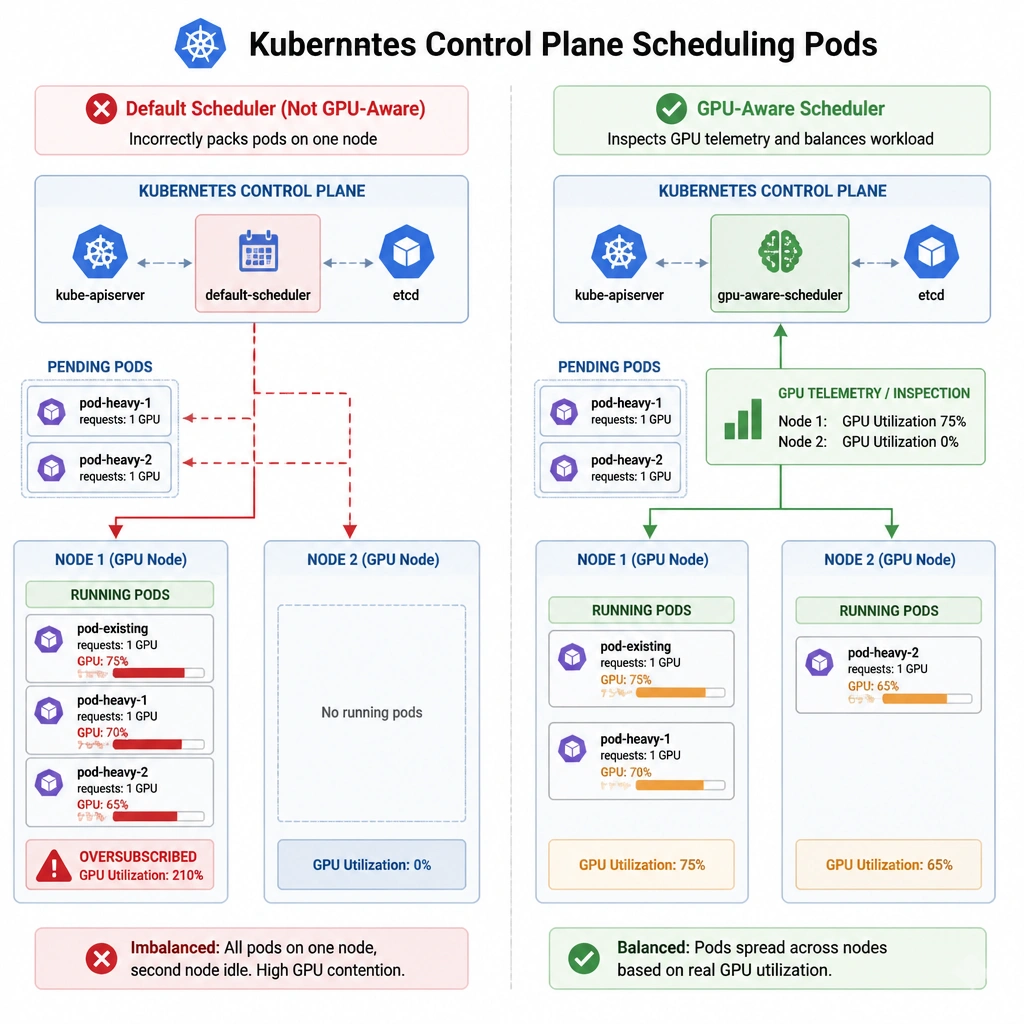
Here's the deal: standard Kubernetes is great at managing CPUs and RAM, but out of the box, it is completely blind to what's happening inside your GPUs. It sees a GPU as a binary resource—either it's there or it's not. So it might schedule three heavy inference pods on the same GPU node while another node sits there doing nothing! Talk about a performance killer. To fix this, you need to deploy a GPU-aware scheduler. This smart piece of software looks at actual GPU telemetry, like memory and utilization, and even NVLink connections. It makes sure your pods get sent to the node that actually has the free GPU cycles to handle them. CPU-based autoscaling won't help you here because your CPUs aren't the ones doing the heavy lifting!
Full explanation below image
Full Explanation
In a standard Kubernetes cluster, the default scheduler makes decisions based on CPU and system memory (RAM) requests and limits. It lacks visibility into GPU-specific metrics (such as GPU memory usage, temperature, or compute utilization) and topology (such as NVLink connections between GPUs). Consequently, it may place multiple GPU-intensive pods on the same node, causing resource contention, while other GPU nodes remain underutilized. To resolve this imbalance, organizations deploy a GPU-aware scheduler (such as NVIDIA's GPU-aware scheduling stack or custom scheduler plugins). A GPU-aware scheduler integrates with the Kubernetes control plane and gathers real-time telemetry from nodes via agents like the NVIDIA Device Plugin and DCGM. It evaluates parameters like GPU memory capacity, topology, and current utilization when determining the optimal node for a pod. This ensures balanced distribution of inference workloads, prevents hot-spotting, and maintains consistent low latency. Let's analyze the incorrect options: - CPU-based autoscaling (Option A) monitors host CPU usage, which is a poor proxy for GPU workloads; an inference container might max out a GPU while consuming very little CPU, leaving the autoscaler unresponsive. - Reducing the number of GPU nodes (Option C) decreases overall cluster capacity and worsens performance congestion, rather than balancing the existing workload. - GPU resource quotas (Option D) limit the maximum number of GPUs a team or namespace can allocate, but they do not solve the scheduling problem of how pods are distributed across the physical nodes. Furthermore, GPU-aware scheduling is critical when running distributed multi-node training workloads (such as PyTorch Elastic/Torchrun). The scheduler can ensure that pods belonging to the same training job are scheduled on nodes with high-speed interconnects (NVLink and InfiniBand) rather than scattered across nodes separated by slower ethernet switches, minimizing communication latency. Thus, a GPU-aware scheduler is the correct and most effective architectural solution.