Your enterprise is deploying a high-performance AI infrastructure to accelerate machine learning workloads across a distributed environment containing multiple NVIDIA GPUs. To optimize parallel computation on the GPU cores and streamline high-speed communication between the GPUs, which two tools or frameworks must be integrated into the system? (Choose two)
Select all correct answers, then click Submit.
Short Explanation and Infographic
Okay, let's dive in. When you're building a massive distributed GPU cluster, you need two things to happen: your GPUs need to compute the math at lightning speed, and they need to talk to each other without bottlenecks. The foundation of all NVIDIA GPU computing is CUDA (Option D). Think of CUDA as the translator that lets your high-level code talk directly to the thousands of parallel cores on the graphics card. But when you hook up multiple GPUs across a network, they need to swap gradients and weights constantly during training. If they use standard CPU networking, everything slows to a crawl. That's where NCCL (Option A) comes in. It provides highly optimized routines like AllReduce that let GPUs communicate directly with each other at the hardware level. Keras (Option C) is just a high-level API, TensorFlow Serving (Option B) is for inference deployment, and NGC (Option E) is a repository for containers—none of those handle the raw computation and inter-GPU communication. Got it? Sweet.
Full explanation below image
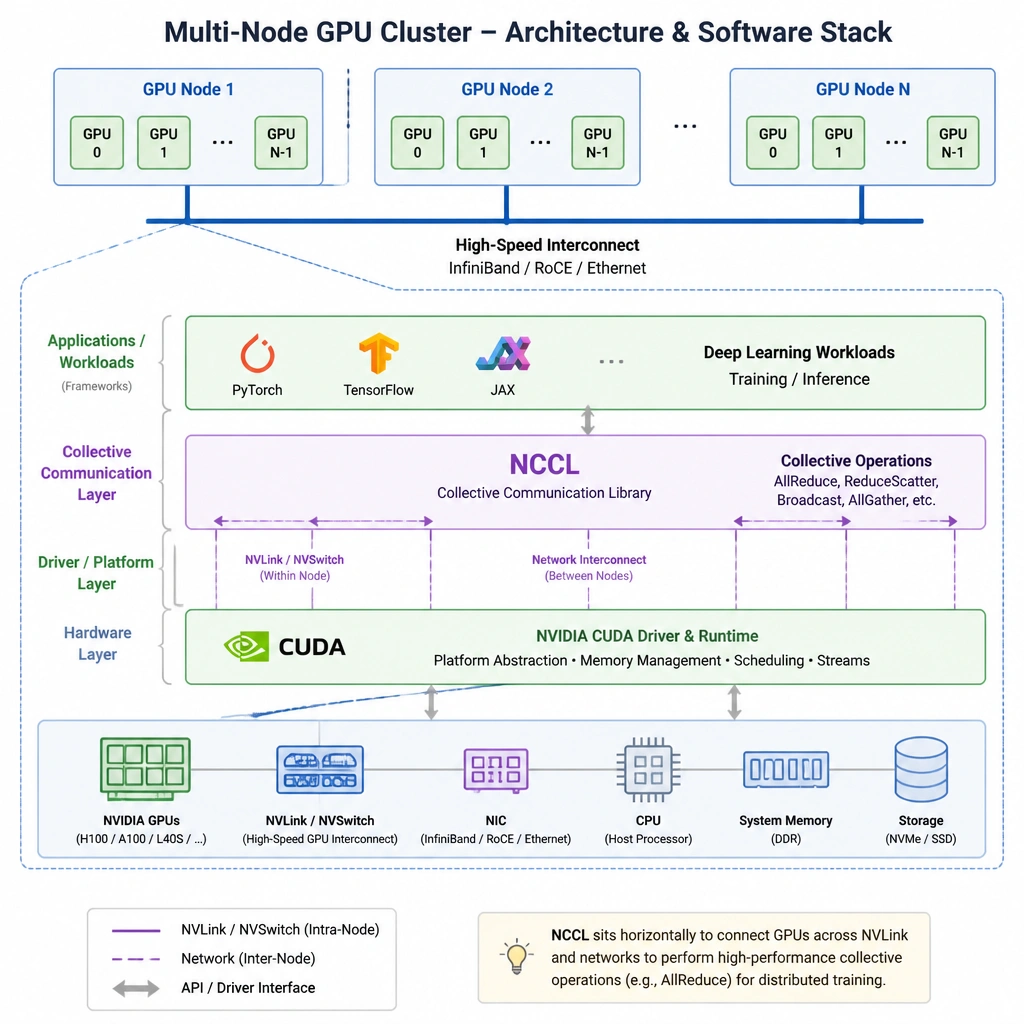
Full Explanation
Scaled deep learning workloads on distributed NVIDIA GPU clusters rely on a combination of parallel computing capabilities and efficient inter-GPU communication.
1. NVIDIA CUDA (Option D): The Compute Unified Device Architecture (CUDA) is NVIDIA's parallel computing platform and programming model. It exposes the GPU's highly parallel architecture to developers, enabling them to execute general-purpose mathematical operations on thousands of GPU cores simultaneously. CUDA is the fundamental software layer that accelerates deep learning frameworks like PyTorch and TensorFlow. 2. NVIDIA NCCL (Option A): The NVIDIA Collective Communications Library (NCCL, pronounced 'Nickel') provides multi-GPU and multi-node collective communication primitives. These include highly optimized routines like AllReduce, AllGather, Broadcast, and ReduceScatter, which are tailored to maximize throughput and minimize latency over PCIe, NVLink, and network interconnects (like InfiniBand with GPUDirect RDMA). This is essential for synchronizing weights and gradients across distributed training nodes.
Analyzing the incorrect options: - Option B (TensorFlow Serving) is an inference hosting system designed to deploy models in production via gRPC or REST APIs, rather than optimizing parallel training workloads. - Option C (Keras) is a high-level user-facing API for building neural networks. While it runs on top of backend engines like TensorFlow, it does not handle low-level GPU compute acceleration or communication. - Option E (NVIDIA NGC) is a software portal and registry offering pre-trained models and GPU-optimized containers, but it is not a runtime programming model or communication library.
Integrating CUDA and NCCL ensures that both the compute and communications pathways are fully accelerated, preventing bottlenecks during distributed AI training.