While neural network theories and algorithmic models have existed for decades, what technological breakthrough has been the primary driver behind the recent practical breakthroughs and industrial adoption of deep learning?
Select an answer to reveal the explanation.
Short Explanation and Infographic
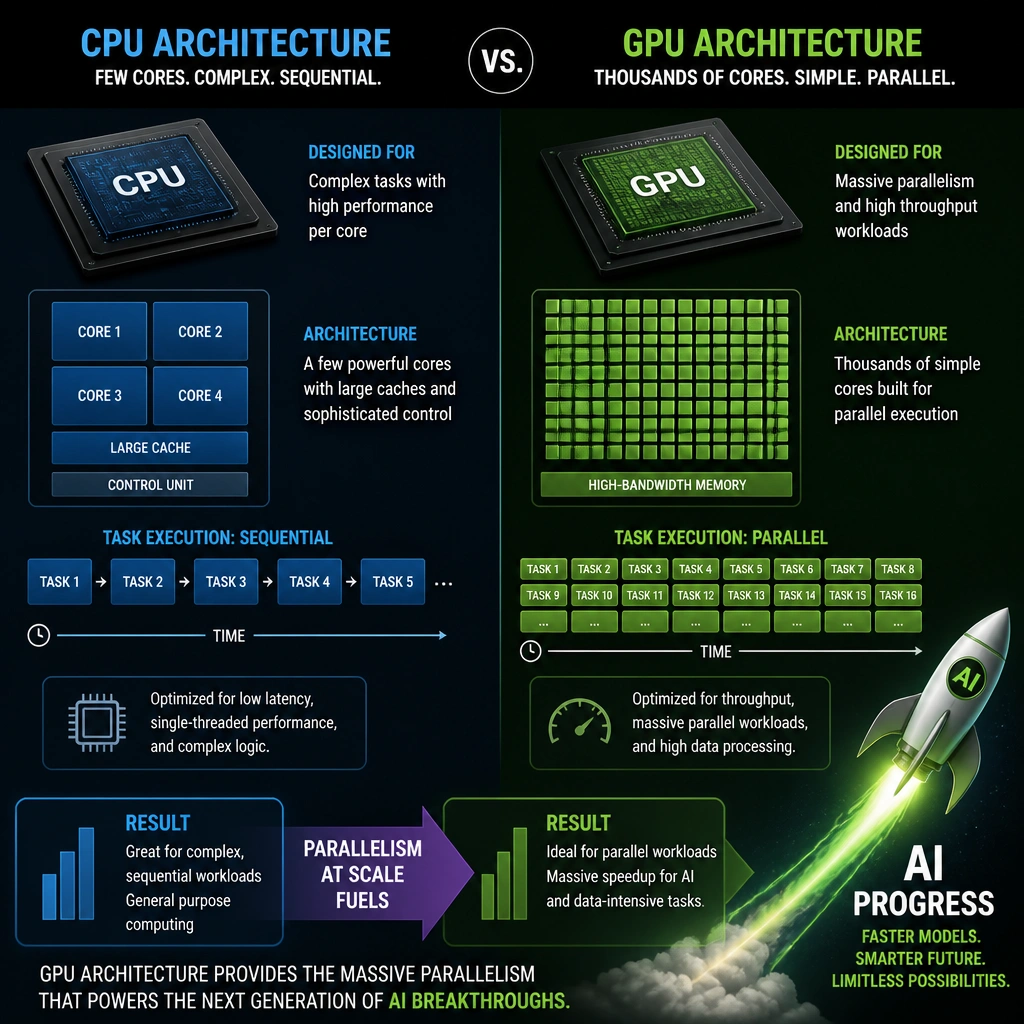
Here's the deal: researchers have had the math for neural networks since the 1980s. But back then, trying to train a decent model on a standard CPU would take years, if not decades. It was a complete non-starter! Everything changed when we realized we could repurpose GPUs—which were designed to compute millions of pixels for video games in parallel—to compute matrix multiplications for neural networks. Specialized hardware like NVIDIA GPUs and Google TPUs blew the doors wide open, turning training times from months into hours. That raw compute power is what made modern AI practical and usable in the real world.
Full explanation below image
Full Explanation
The sudden acceleration of artificial intelligence over the past decade is often described as a convergence of three factors: algorithms, data, and compute. However, the critical catalyst that transformed deep learning from theoretical academic research into practical, industry-changing technology was the availability of massive computational power provided by specialized hardware. 1. Parallel Processing Power: Traditional CPUs are designed for sequential processing, featuring a few powerful cores optimized for handling complex single-thread tasks. In contrast, GPUs (Graphics Processing Units) contain thousands of simpler cores designed to execute simple mathematical operations concurrently. Because deep learning is fundamentally built on massive matrix multiplications and vector operations, the parallel architecture of GPUs (and later, Application-Specific Integrated Circuits like TPUs) is uniquely suited to accelerate these calculations. 2. Enabling Larger Models: This compute leap enabled researchers to train networks with billions of parameters on vast datasets. Without hardware acceleration, training models like modern LLMs or deep convolutional networks would be computationally infeasible due to the sheer time required to complete a single training epoch.
Why Distractors are Incorrect: A) The standardization of data exchange formats like ONNX: Open Neural Network Exchange (ONNX) is a great tool for model interoperability between different frameworks, but it is a relatively recent software standard and did not drive the fundamental boom of AI capabilities. B) The massive growth in structured database storage capabilities: Although data is essential, storage capacity alone cannot train a model. CPUs could not process this scale of data fast enough to make deep learning viable. * D) The development of low-power CPU architectures for mobile devices: Low-power CPU architectures (like ARM) are critical for edge computing and mobile battery life, but they do not possess the raw parallel compute density required to train large-scale AI models.