A retail company wants to deploy a real-time computer vision system across hundreds of physical stores to analyze foot traffic and detect theft at checkout registers. The system must process high-definition video feeds locally with sub-millisecond response times and low power consumption. Which NVIDIA compute platform is specifically designed to meet these edge deployment requirements?
Select an answer to reveal the explanation.
Short Explanation and Infographic
Here's the deal: if you try to send high-definition video from hundreds of retail stores up to a centralized cloud database for processing, your bandwidth bill is going to be astronomical, and your latency will be terrible. You need to process that data right there on-site at the edge. But you also can't put a loud, power-hungry server under every checkout counter. That's where NVIDIA Jetson fits in perfectly. It's a tiny, power-sipping system-on-module that packs a punch with hardware-accelerated AI compute. It lets you run deep learning models locally, right next to the camera sensor, giving you near-zero latency and keeping your data private. Got it? Jetson is your go-to for edge AI.
Full explanation below image
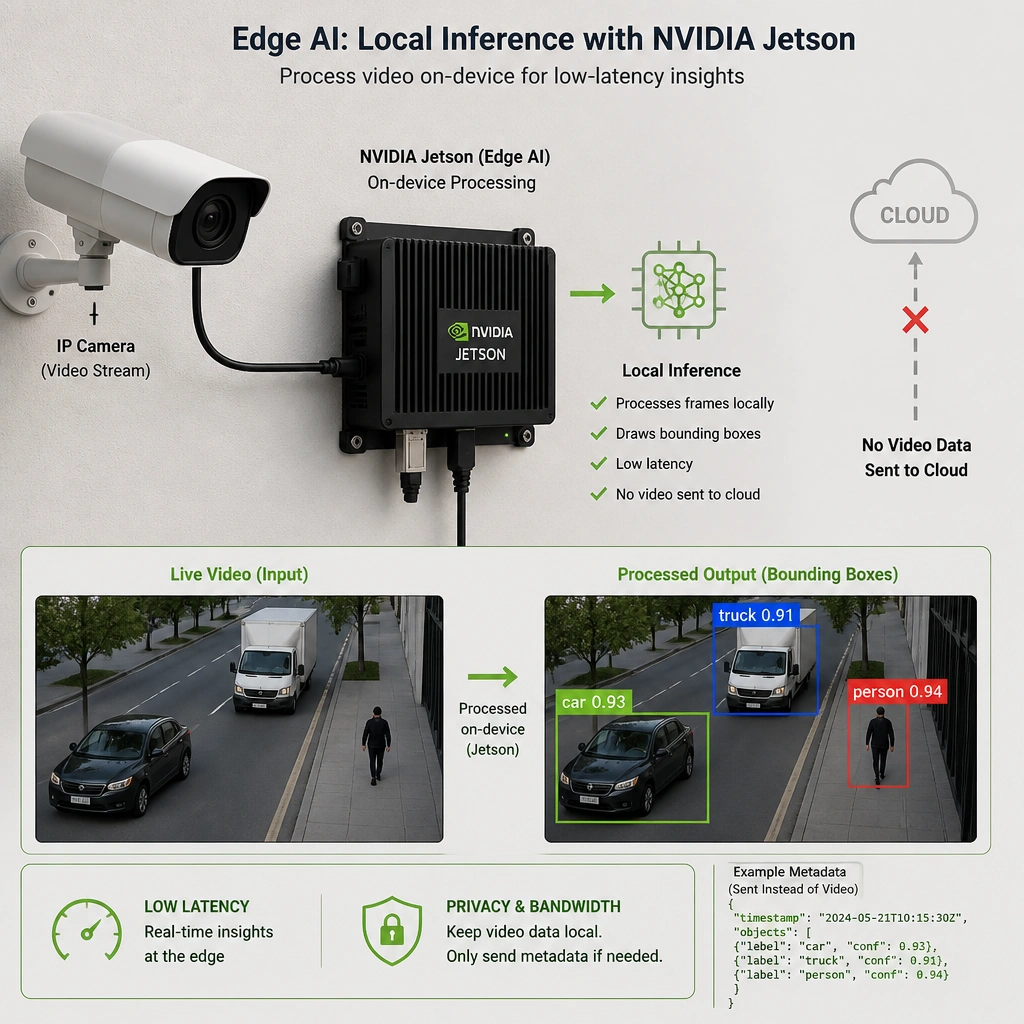
Full Explanation
Processing AI workloads at the edge requires hardware that fits strict constraints regarding physical size, power availability, thermal dissipation, and cost, while still delivering enough throughput for real-time inference. 1. NVIDIA Jetson Platform: The Jetson family (including Jetson Nano, Xavier, and Orin) is built specifically for edge AI and autonomous machines. These devices are System-on-Modules (SoMs) that integrate an ARM CPU, an NVIDIA GPU, and specialized hardware accelerators (like Deep Learning Accelerators or DLAs). By running models directly on Jetson hardware located near the data source (cameras, sensors), systems eliminate the latency, bandwidth consumption, and security risks associated with round-trip cloud communication.
Why Distractors are Incorrect: B) NVIDIA Tesla: Tesla (now generally referred to as NVIDIA Data Center GPUs like the T4, A100, or H100) is a line of GPUs designed for high-performance computing (HPC) and AI training/inference within enterprise data centers. These cards require substantial power (often 70W to 400W+), standard server hosts, and specialized cooling infrastructure, making them unsuitable for edge deployments like retail checkout registers or smart cameras. C) NVIDIA GRID: This is a virtualization platform that enables multiple users to share a single physical GPU, typically used for delivering virtual desktop infrastructure (VDI) and cloud gaming. It is not designed for physical edge device deployments. * D) NVIDIA RTX: The RTX platform encompasses consumer and professional workstation graphics cards (GeForce RTX and RTX professional). While highly capable, they are designed for desktops and workstations, draw significant power, and lack the small form factor and ultra-low-power profiles required for embedded edge hardware applications.