Your engineering team has trained several complex neural networks for a computer vision project. You now need to deploy these models to run with ultra-low latency across a variety of hardware targets, ranging from cloud-based NVIDIA A100 GPUs to small, power-constrained NVIDIA Jetson edge modules. Which NVIDIA software tool should you use to optimize the models for inference and runtime performance on these target platforms?
Select an answer to reveal the explanation.
Short Explanation and Infographic
Okay, let's dive into inference. Once you've spent days or weeks training your awesome new model, you can't just throw it onto an edge device or a production server and hope for the best. It's going to run slow, and it's going to eat up resources. Trust me on this: you need a way to tune that model for the specific hardware it's running on, whether that's a beastly A100 in the cloud or a tiny Jetson Nano on a drone. That's where NVIDIA TensorRT comes into play. It takes your trained model, fuses layers together, gets rid of unused operations, and optimizes memory usage. It's like taking a race car, stripping out the passenger seats and the air conditioning, and tuning the engine so it flies around the track. Got it? Sweet. TensorRT is your go-to for making models fast!
Full explanation below image
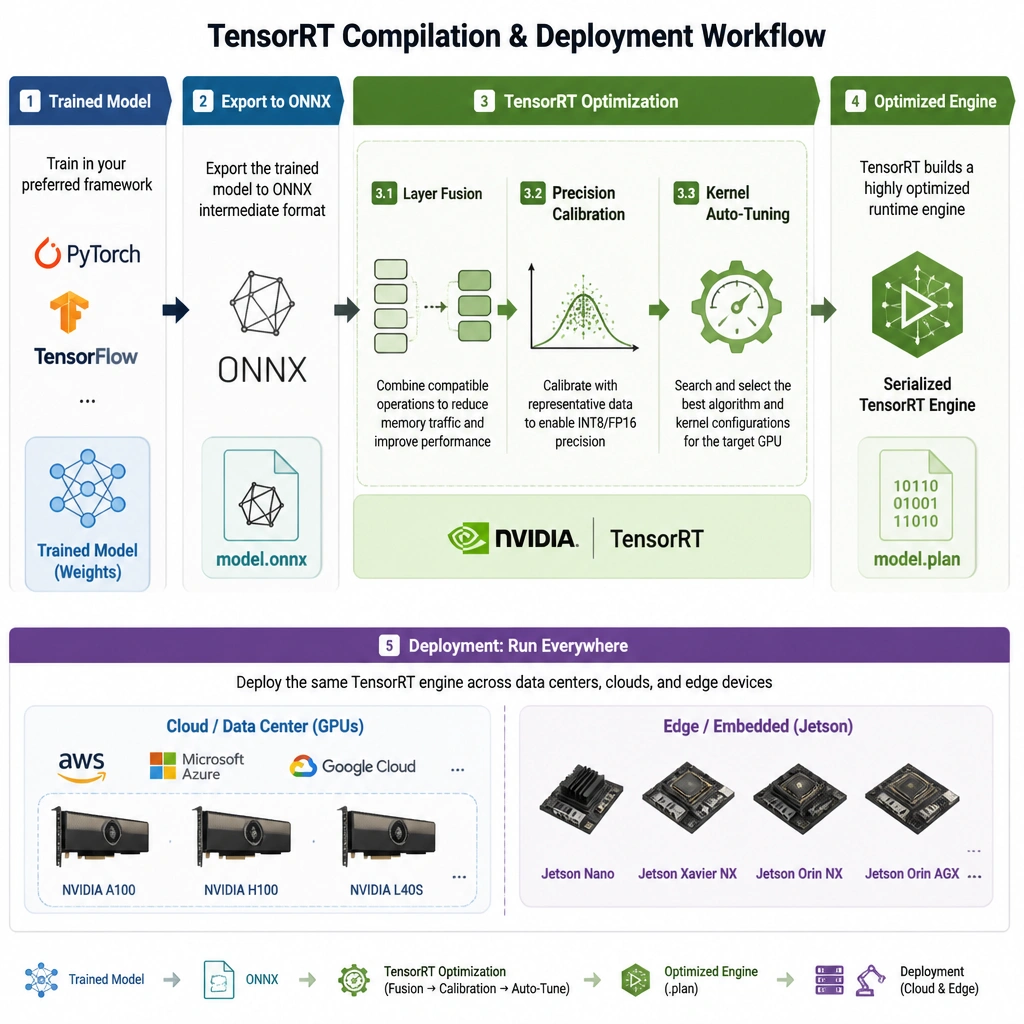
Full Explanation
NVIDIA TensorRT is a high-performance deep learning inference optimizer and runtime library designed to deliver low latency and high throughput for deep learning inference applications. When deploying models to diverse environments—such as data centers, embedded systems, or edge devices—TensorRT optimizes the network by restructuring the computational graph. It performs key optimizations including: 1. Layer and Tensor Fusion: It combines multiple layers (like convolution, bias, and ReLU) into single nodes, reducing memory transfers and kernel launch overhead. 2. Precision Calibration: It can convert models from FP32 (single-precision floating-point) to FP16 or INT8 precision without significant loss of accuracy, which greatly accelerates execution on hardware with Tensor Cores. 3. Kernel Auto-Tuning: It selects the optimal algorithms (kernels) for the specific target GPU architecture. 4. Dynamic Tensor Memory: It minimizes memory footprint by reusing memory allocations for intermediate tensors.
Let's examine why the other choices are incorrect: - NVIDIA RAPIDS is a suite of open-source software libraries built on CUDA for accelerating data science, machine learning pipelines, and data analytics (such as pandas and scikit-learn replacements), not for deep learning inference optimization. - NVIDIA Triton Inference Server is an inference serving software that manages model execution on CPUs and GPUs, handling client requests, dynamic batching, and concurrent model execution. While Triton often runs TensorRT-optimized models, Triton itself is the server wrapper, not the optimizer that restructures the model for edge and cloud deployment. - NVIDIA DIGITS (Deep Learning GPU Training System) was an interactive web-based tool used for designing and training deep learning models, but it is now deprecated and does not perform cross-platform inference optimization.