An engineer is training a large language model across an 8-GPU node. During execution, the engineer notices that while two of the GPUs are constantly pegged at 98% utilization, the other six regularly drop to 0% utilization for several seconds at a time, resulting in poor overall training throughput. What is the most likely cause of this behavior, and how should it be addressed?
Select an answer to reveal the explanation.
Short Explanation and Infographic
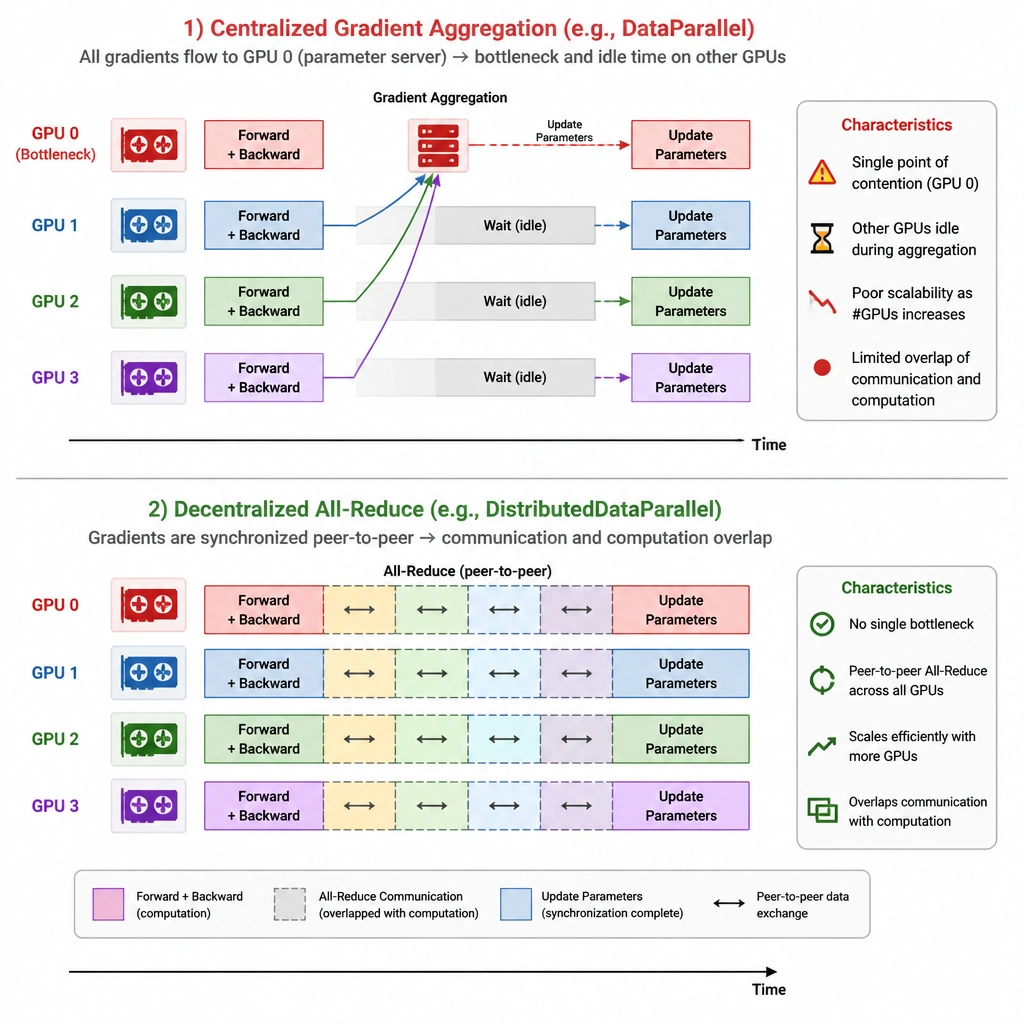
Check this out: you've got this massive, expensive cluster of GPUs, and you're expecting lightning-fast training times. But when you check the console, half your cards are just sitting there twiddling their thumbs. What gives? Here's the deal: in a multi-GPU setup, these cards have to talk to each other to share their gradients and stay in lockstep. If your synchronization is off—say, you're using an inefficient distribution strategy or your workload is unbalanced—some GPUs will blast through their data and then just park in idle while they wait for the slower cards to finish. It's like a group project in school where you finish your part in five minutes but can't turn it in until the slacker of the group finally finishes theirs. To fix this, you need a solid distributed framework like PyTorch's DistributedDataParallel to balance the load and keep those GPUs hummin'!
Full explanation below image
Full Explanation
In multi-GPU deep learning training, parallelization is typically achieved using data parallelism, where the dataset is split into batches and distributed across multiple GPUs. Each GPU processes its batch and computes its own gradients. However, before the model weights can be updated for the next step, these gradients must be aggregated and synchronized across all participating GPUs.
If the synchronization mechanism is inefficient or improperly configured, it introduces a severe bottleneck. For instance, using PyTorch's basic DataParallel wrapper runs the training process in a single-process, multi-threaded fashion. This means that a single GPU (usually GPU 0) acts as the master node, gathering all gradients, calculating the average, and broadcasting the updated weights back to the other GPUs. During this aggregation and broadcast phase, the other GPUs remain completely idle, waiting for GPU 0 to finish.
To resolve this issue, engineers use advanced distributed training frameworks such as PyTorch's DistributedDataParallel (DDP) or TensorFlow's MirroredStrategy. DDP spawns a separate process for each GPU, eliminating the single-thread bottleneck. It utilizes an all-reduce algorithm (often implemented via NVIDIA's NCCL library) to perform gradient aggregation in a decentralized, parallelized manner. This overlaps the backward pass computation with gradient communication, dramatically reducing synchronization wait times and ensuring high GPU utilization.
Let's analyze the incorrect options: - Insufficient GPU memory (OOM) would trigger a runtime error and halt the training process entirely rather than causing periodic idling. - A CPU bottleneck in data preprocessing would indeed slow down training, but it would typically affect all GPUs uniformly as they wait for the next batch from the host CPU, rather than causing specific GPUs to wait for others. - Model architecture simplicity might limit the benefits of scaling, but it does not cause GPUs to sit idle due to synchronization delays; it would simply result in low utilization across all devices without the characteristic synchronization wait states.