An operations administrator manages a high-performance computing cluster dedicated to training LLMs. To implement a predictive maintenance strategy that flags failing hardware before it causes training jobs to crash, which GPU telemetry metric should the administrator monitor most closely as an early indicator of physical hardware degradation?
Select an answer to reveal the explanation.
Short Explanation and Infographic
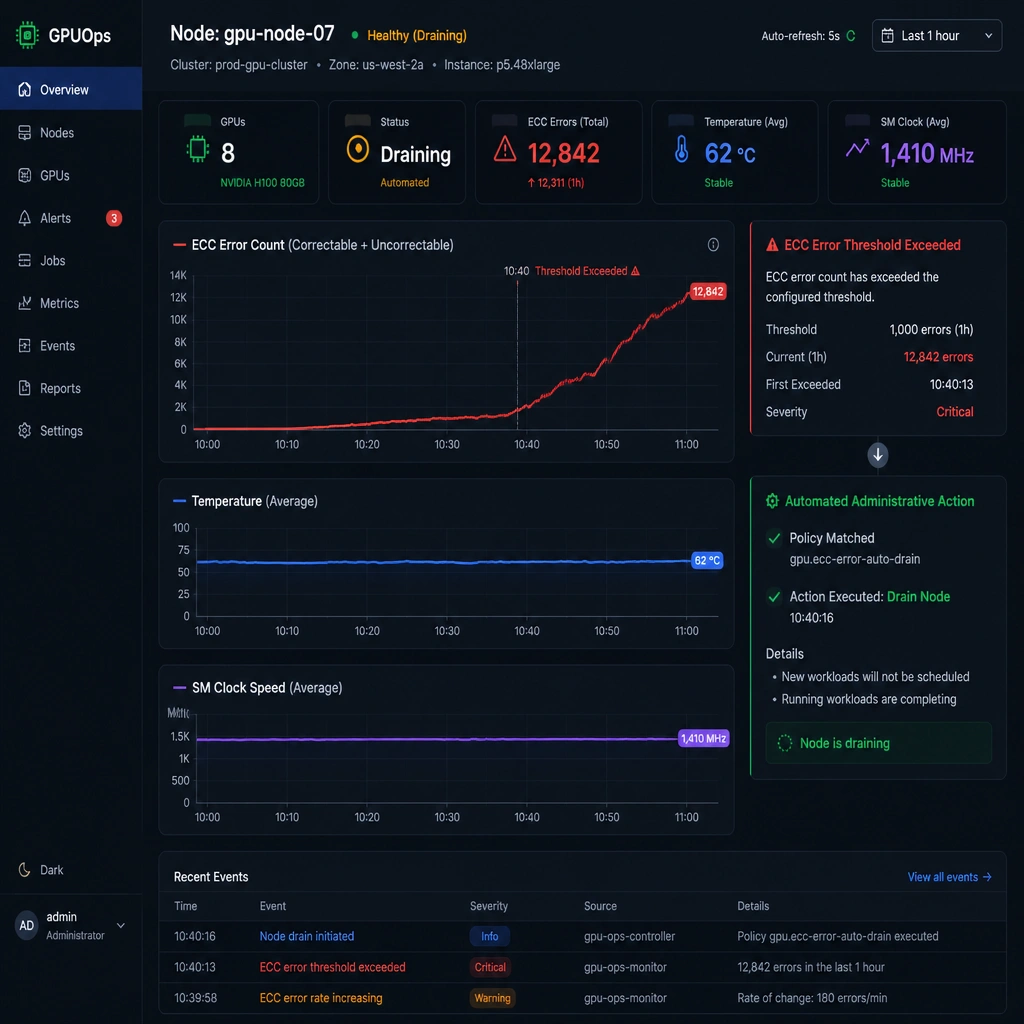
Imagine your boss walks in and says, 'Every time we run a 30-day training run, one of our nodes drops dead and ruins the whole batch. Fix it!' Now, what do you look at? Sure, keeping an eye on temperature is good practice, but if a GPU is physically wearing out or has bad memory blocks, temperature might look totally normal right up until the crash. The real gold mine for predicting hardware failure is tracking ECC (Error-Correcting Code) errors. These are memory errors that the hardware detects and corrects behind the scenes. A few here and there might be normal, but when you see a sudden spike in ECC errors, that GPU is screaming for help. It means the memory chips are failing, and a catastrophic double-bit error is right around the corner. Pay close attention to this, because it'll save your bacon in production!
Full explanation below image
Full Explanation
Predictive maintenance in GPU clusters relies on detecting early, sub-critical hardware anomalies before they escalate into hard failures that crash active training jobs. Modern enterprise GPUs, such as NVIDIA's Hopper or Ampere architectures, utilize Error-Correcting Code (ECC) memory to detect and correct single-bit memory errors on the fly.
While ECC prevents immediate data corruption, a rising frequency of corrected single-bit ECC errors is a primary indicator of physical memory cell degradation, high electrical noise, or thermal stress on the GPU board. If unaddressed, these errors often lead to uncorrectable double-bit errors, which immediately halt the GPU and crash the software execution. Monitoring ECC error rates via tools like NVIDIA System Management Interface (nvidia-smi) or NVML allows administrators to drain workloads from a degrading node and replace the hardware proactively.
Let's look at why the other options are not the best choice: - GPU temperature and fan speed are important for identifying thermal throttling or cooling issues, but they do not directly flag physical memory degradation or internal silicon defects that occur at normal operating temperatures. - GPU clock speed fluctuates dynamically based on workload and power limits; it is not a metric for predicting hardware failure. - CPU utilization measures the host processor's workload, which has no direct relevance to the hardware integrity of the PCIe-attached GPUs.