An enterprise is designing its infrastructure to support three distinct AI workloads: a real-time smart city video analytics system that requires ultra-low latency and strict data privacy, a periodic heavy training pipeline for a massive CNN image classifier, and massive batch-processing tasks for telemetry data. Which infrastructure architecture best balances the requirements for cost, scalability, and latency across these diverse workloads?
Select an answer to reveal the explanation.
Short Explanation and Infographic
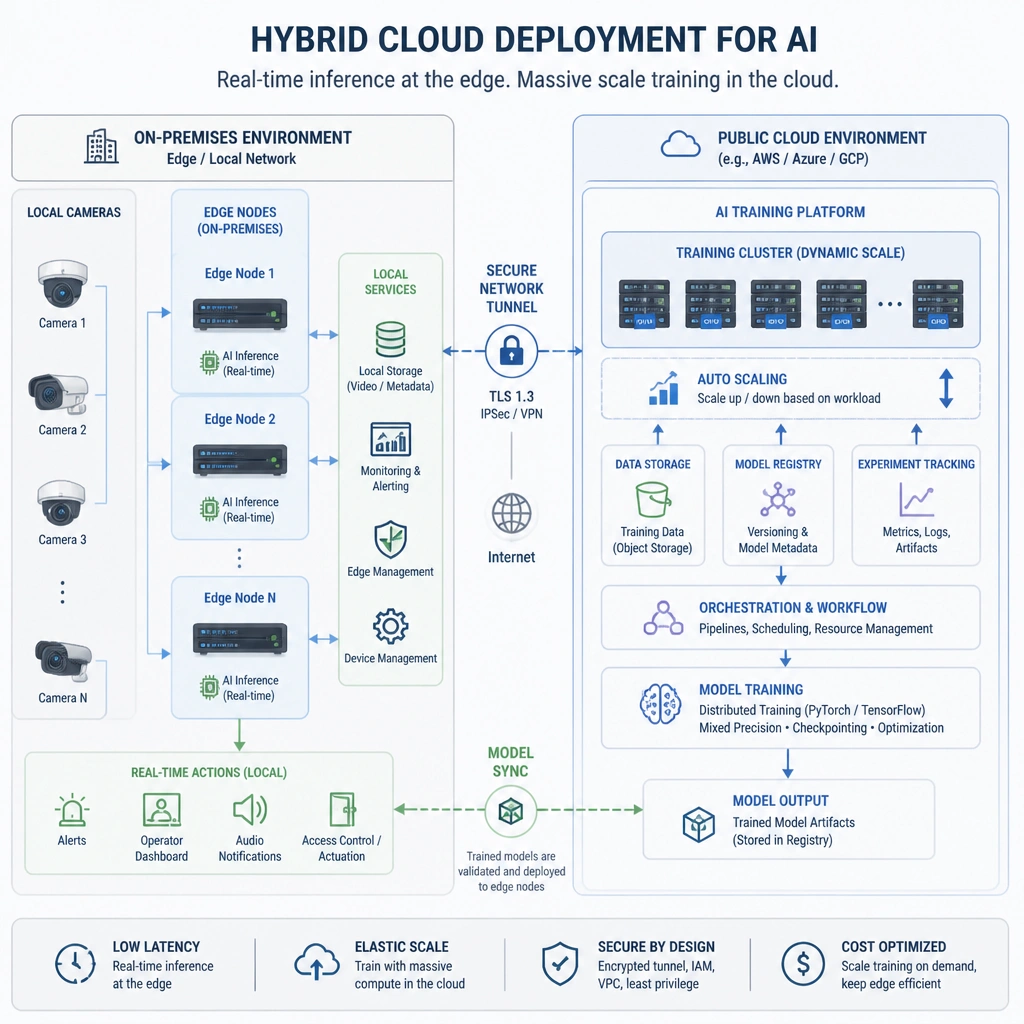
Let's look at this from a real-world perspective. You've got three completely different jobs here. First, you've got real-time video analytics—meaning you need speed and privacy, and you can't afford the latency of shipping gigabytes of video to the cloud and back. That's a perfect candidate for local, on-prem servers. Second, you've got a massive CNN model that you only train once in a while. If you buy enough local GPUs to train that beast, they'll sit empty and gather dust 90% of the time. Not very efficient! Instead, you want to spin up cloud resources for that heavy training lift, and then spin them back down when you're done. By combining on-prem edge gear for local low-latency work with public cloud scale for training, you get the best of both worlds. That's the power of a hybrid cloud!
Full explanation below image
Full Explanation
A hybrid cloud architecture is the optimal choice for organizations running diverse AI workloads with conflicting infrastructure demands. In this scenario, the workloads have highly distinct requirements: 1. Real-time Video Analytics: This workload requires ultra-low latency and often operates under strict compliance or data sovereignty constraints (e.g., local security camera feeds). Processing this data on-premises (at the edge or in a local private cloud) avoids latency, reduces WAN bandwidth costs, and maintains data privacy. 2. CNN Model Training: Training deep learning models is highly compute-intensive but episodic. Buying enough on-premises GPU servers to handle these peak training loads can lead to low overall utilization and high capital expenditure (CapEx). Leveraging the public cloud allows the organization to scale up hundreds of GPUs on-demand and pay only for the compute time used (OpEx). 3. Batch Processing: Telemetry data can be processed during off-peak hours using low-cost cloud resources like spot instances.
Let's evaluate the incorrect options: - Dedicated on-premises CPU nodes lack the parallel processing power of GPUs required for deep learning training and real-time video analytics, causing severe performance bottlenecks. - A fully serverless cloud infrastructure is poorly suited for long-running, high-throughput tasks like training massive CNNs, and it would introduce unacceptable latency and bandwidth costs for real-time video analytics. - An entirely on-premises private cloud would require a massive initial capital investment to support peak training workloads, leading to idle, underutilized hardware during normal operations.