A telecommunications provider is deploying a high-throughput, low-latency AI pipeline to analyze traffic patterns from millions of network endpoints in real time. The infrastructure must handle massive packet processing, security encryption, and telemetry parsing without bottlenecking the host CPUs. Which NVIDIA technology combination should be used to offload these network-infrastructure workloads and manage them programmatically?
Select an answer to reveal the explanation.
Short Explanation and Infographic
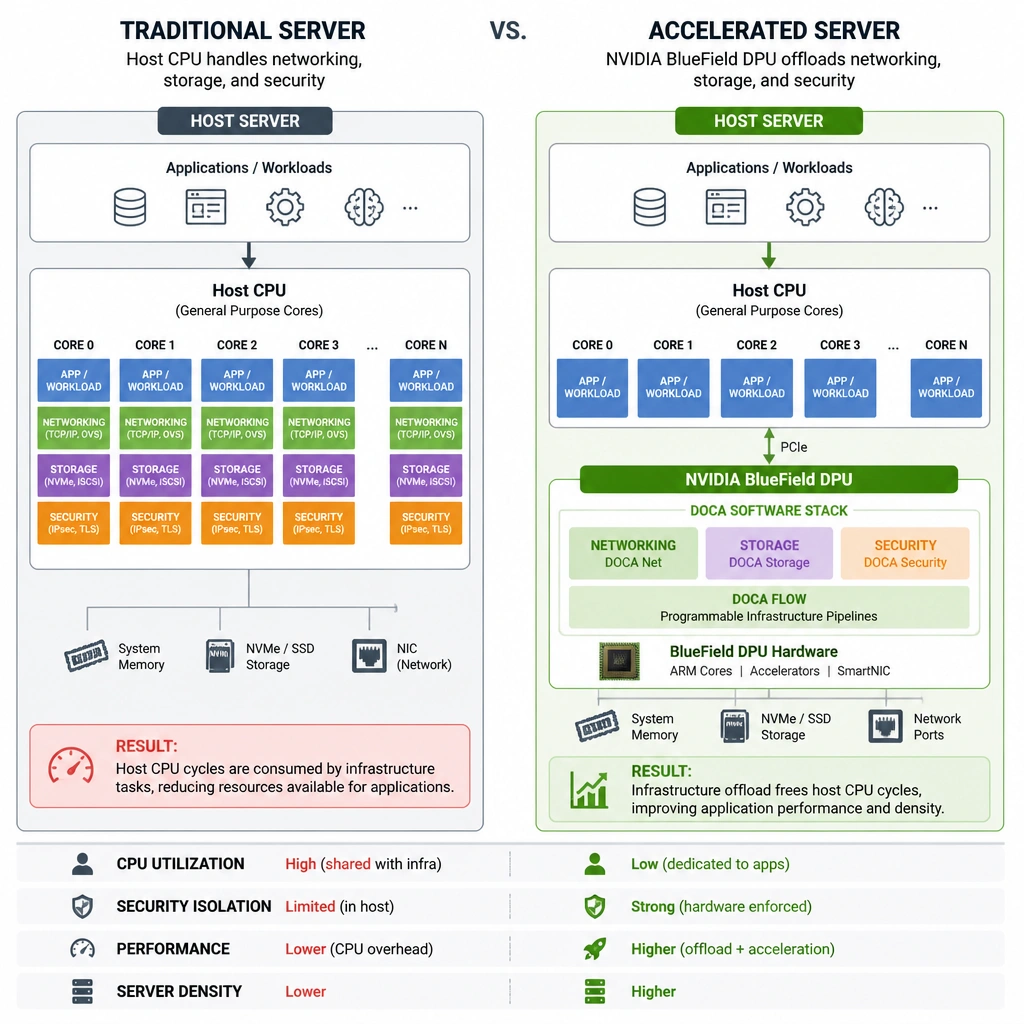
Check this out: in modern data centers, we're talking about massive amounts of data flying around at 100Gbps or 200Gbps. If your host CPUs have to spend all their cycles just processing network packets, running security checks, and routing traffic, they won't have any horsepower left for your AI applications! That's called the 'tax' on the CPU. Enter the DPU—the Data Processing Unit. NVIDIA's BlueField DPUs are basically mini-servers on a card that slide into your PCIe slot to handle all that networking, security, and storage offloading. And how do you program and control these DPUs? That's where DOCA comes in. Think of DOCA as the CUDA of the networking world. It gives you the APIs and libraries to build software-defined, accelerated applications on the DPU, keeping your network fast, secure, and highly scalable. Sweet!
Full explanation below image
Full Explanation
In modern high-speed networks, processing packets, managing security policies (like encryption/decryption), and performing telemetry ingestion can consume up to 30% of host CPU cycles. To alleviate this overhead in large-scale AI infrastructures, NVIDIA introduced the Data Processing Unit (DPU).
NVIDIA BlueField DPUs combine powerful Arm CPU cores, high-speed network interfaces, and dedicated hardware acceleration engines for cryptography, storage, and networking. By deploying BlueField DPUs, data centers can offload networking tasks (like OVS, RDMA/RoCE, and firewalls) directly to the DPU. This frees up host CPU and GPU resources to focus purely on running AI applications and training pipelines, reducing overall system latency and improving throughput.
To program and orchestrate these DPUs, NVIDIA provides the DOCA (Data Center Infrastructure-on-a-Chip Architecture) SDK. DOCA is a software framework that provides industry-standard APIs, libraries, and runtime environments. It allows developers to write applications that run on the BlueField DPU to manage network traffic, security policies, and storage virtualization, enabling software-defined control and orchestration of network infrastructure.
Let's examine why the other options are incorrect: - NVIDIA DGX-1 with CPU-based deployment is an outdated architecture (using Kepler/Pascal/Volta generation concepts) and does not address the real-time networking offload required for millions of devices. - Tesla P100 GPUs and TensorFlow Serving are designed for deep learning model inference, not for accelerating low-level network packet processing and infrastructure tasks. - NVIDIA Jetson Xavier NX is an embedded system designed for low-power edge AI applications (like smart cameras), not for handling core telecommunications data center routing, switching, and packet offloading.