You are managing a shared enterprise GPU cluster used for various AI projects. To maximize overall GPU utilization and ensure that urgent, high-priority model training runs are not delayed in the queue behind long-running, low-priority batch jobs, which scheduling strategy should you implement?
Select an answer to reveal the explanation.
Short Explanation and Infographic
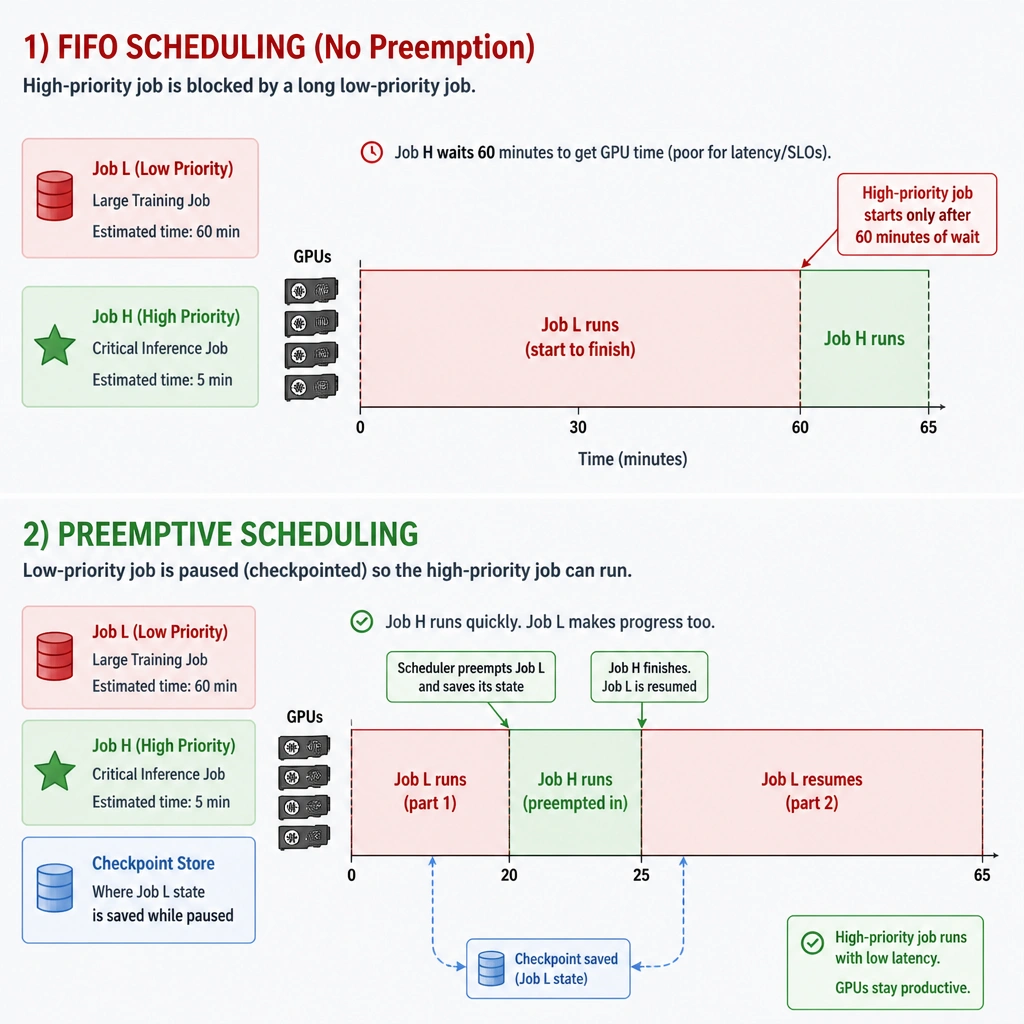
Here's the deal: when you've got a busy cluster, everyone wants their jobs run now. If you use a simple first-in, first-out (FIFO) scheduler, a massive, low-priority training job that runs for a week could block a critical, high-priority job from running. Not very efficient! To solve this, you want to implement preemptive scheduling. Think of it like a hospital emergency room—if someone comes in with a scratch, and someone else comes in with a major injury, the doctor sees the urgent case first. Preemptive scheduling does the exact same thing for your GPUs. It pauses or checkpoint-saves the low-priority job, runs the high-priority job immediately, and then resumes the lower-priority job once the critical work is done. This keeps your GPUs pinned at high utilization while making sure your most important jobs get done on time. Trust me, in a production cluster, preemption is a lifesaver!
Full explanation below image
Full Explanation
Managing resource scheduling in a shared high-performance computing (HPC) or AI cluster requires balancing fairness, utilization, and responsiveness. When multiple users submit jobs ranging from small interactive debugging sessions to massive distributed training runs, static or basic scheduling algorithms often lead to high queuing times for critical workloads.
Preemptive scheduling is the most effective strategy to optimize resource utilization while minimizing queue wait times for critical tasks. In a preemptive scheme, the cluster scheduler (e.g., Slurm, Kubernetes with Volcano, or Run:ai) evaluates the priority of incoming jobs. If a high-priority job enters the queue and no resources are free, the scheduler preempts (suspends, checkpoint-saves, or terminates) a running lower-priority job to free up GPUs immediately. Once the high-priority job completes, the preempted job is resumed or restarted. This ensures that SLA-critical workloads are processed without delay, while still allowing the cluster to run at near-100% capacity during periods of low activity by running low-priority backfill jobs.
Let's review the other scheduling policies: First-Come, First-Served (FCFS): This policy is fair in terms of submission order but highly inefficient for clusters. A long-running, low-priority job can block short, high-priority jobs indefinitely, leading to high average queue times. Shortest-Job-First (SJF): While this minimizes average queue time, it requires highly accurate, user-provided runtime estimates, which are notoriously difficult to predict for AI workloads. Furthermore, it can lead to 'starvation' for long-running jobs. * Static Allocation: Partitioning the cluster into static pools reduces overall utilization because resources in one pool might sit idle while another pool's queue is backed up, preventing the dynamic sharing of expensive GPU hardware.