An industrial manufacturing firm wants to build a shared, photorealistic digital twin of their assembly line. They need their robotics, mechanical, and AI teams to collaborate in real-time on physical simulations and synthetic data generation. Which NVIDIA platform is purpose-built to support this collaborative, multi-user simulation environment?
Select an answer to reveal the explanation.
Short Explanation and Infographic
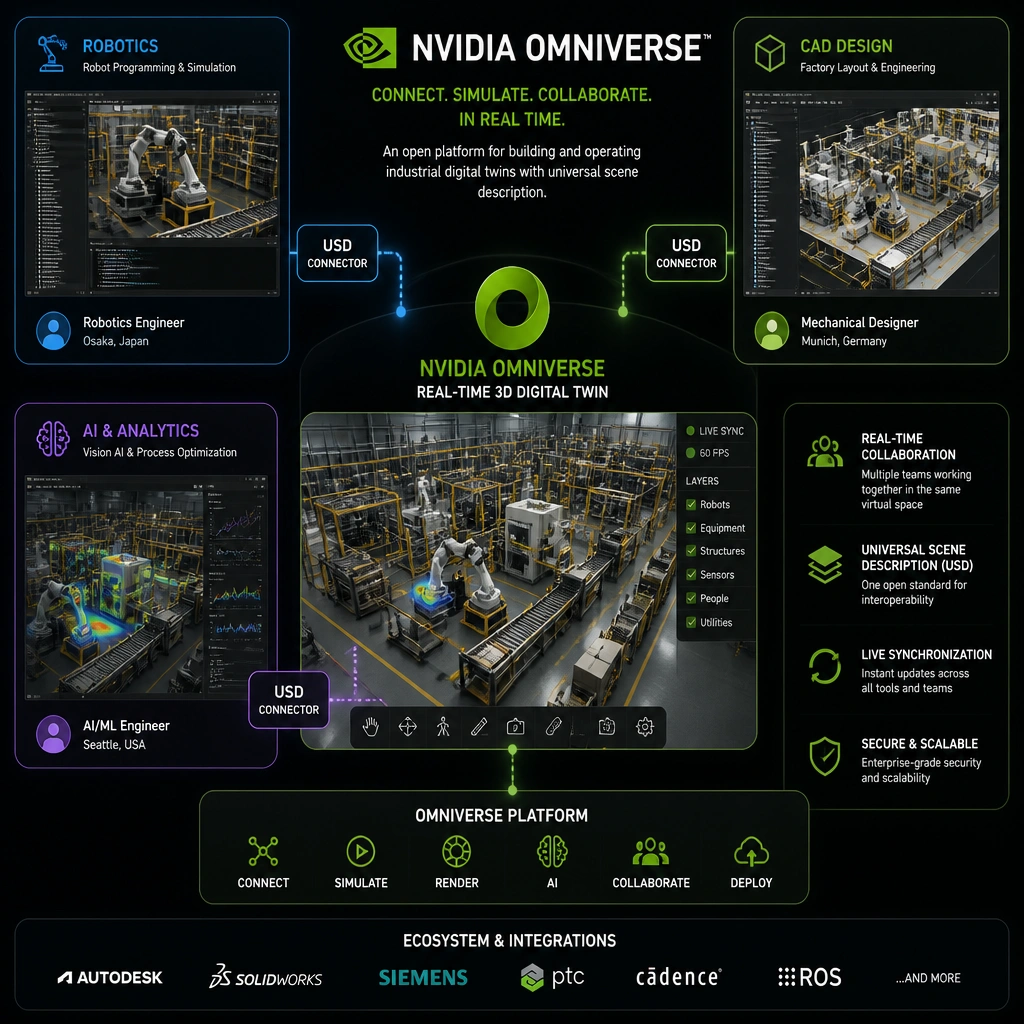
Imagine your boss walks in and says, 'We need to simulate our entire manufacturing floor in 3D, let the robotics team test their AI models in it, and have everyone collaborate in real-time.' If you try to patch together basic game engines and CAD files, you'll end up with a mess. Here's the deal: NVIDIA Omniverse is exactly what you need. It's built from the ground up for real-time, multi-user collaboration and simulation. It uses USD (Universal Scene Description) so different teams can use their favorite tools (like Maya, Blender, or CAD) and see updates instantly in a shared, physically accurate virtual world. It's perfect for training robots, testing self-driving cars, or rendering massive virtual sets. Got it? Sweet!
Full explanation below image
Full Explanation
NVIDIA Omniverse is an open platform built for virtual collaboration and real-time, physically accurate simulation. It allows creators, designers, researchers, and engineers to connect major design tools, assets, and projects to collaborate in a shared virtual space.
At the core of Omniverse is Pixar's Universal Scene Description (USD) format, which acts as the common language for 3D workflows. This enables multi-user collaboration, where team members can work simultaneously on the same virtual scene using different software packages (e.g., CAD, Autodesk, Blender) with real-time updates. In addition, Omniverse integrates advanced NVIDIA RTX ray tracing and physics engines (such as PhysX) to enable realistic simulation of physical environments. This makes it highly valuable for industries like: Robotics (Omniverse Isaac Sim): For training and testing autonomous robots in photorealistic, physically accurate virtual environments before deploying them in the real world. Manufacturing: For creating 'digital twins' of factories to optimize workflows and layout design. * Entertainment: For real-time virtual production and collaborative 3D world-building.
Let's look at why the other options are incorrect: NVIDIA JetPack SDK: JetPack is an SDK specifically designed for building AI applications on NVIDIA Jetson edge devices (like Jetson Nano or Orin). It provides the OS, drivers, and libraries for edge AI, not a collaborative 3D simulation platform. NVIDIA Triton Inference Server: Triton is an open-source inference serving software that simplifies deploying trained AI models at scale in production. It does not handle 3D rendering or physical simulations. * NVIDIA TensorRT: TensorRT is an SDK for high-performance deep learning inference. It optimizes trained neural networks for deployment on NVIDIA GPUs to minimize latency and maximize throughput, rather than serving as a simulation platform.