You are deploying a computer vision pipeline that performs real-time object detection on dozens of live video feeds. Because the density of objects and frame rates vary wildly across the different cameras, static mapping of feeds to specific GPUs leads to some GPUs running hot and dropping frames, while others sit mostly idle. Which of the following distribution strategies will achieve the lowest overall latency and maintain balanced resource usage?
Select an answer to reveal the explanation.
Short Explanation and Infographic
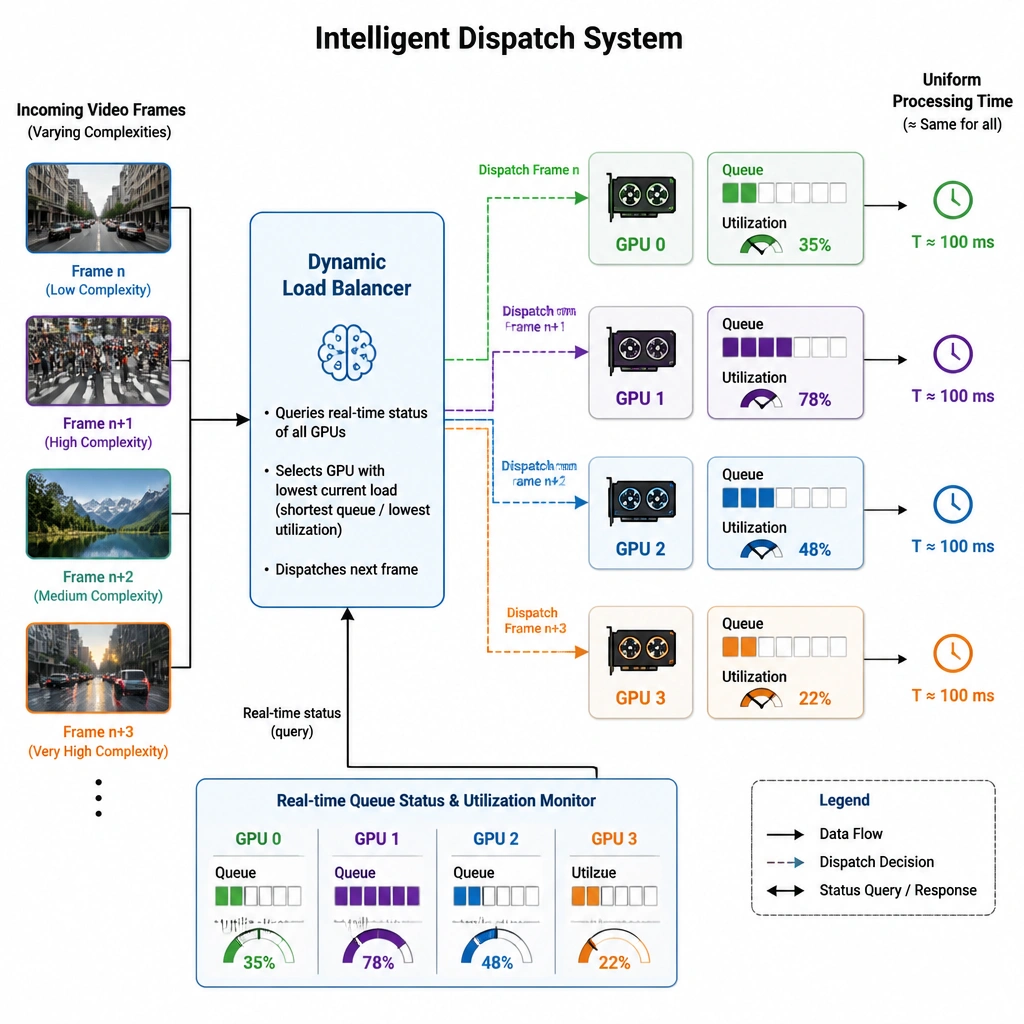
Imagine your boss walks in and says, 'Why is our video analytics stream stuttering? We bought four high-end GPUs!' You check the dashboard and see GPU 1 is pegged at 100%, dropping frames, while GPUs 2, 3, and 4 are basically taking a nap at 10% load. That's a classic scheduling failure. If you just distribute streams randomly or with a dumb round-robin system, a sudden rush of activity on a few cameras will bog down one GPU while the rest of the cluster stays idle. The fix? You need a dynamic load balancer that's smart enough to look at real-time metrics—like active queue depth and GPU utilization—and push work to the card that actually has the breathing room to handle it right now. Pretty simple, right? Keep it dynamic, and your frame drops go away.
Full explanation below image
Full Explanation
Real-time inference workloads, such as multi-stream video analytics, are highly dynamic and variable. The time required to process a video frame depends heavily on the content (e.g., the number of objects to detect) and stream configurations. If workloads are assigned statically or using simple round-robin routing (Option A), it is common to experience temporary load imbalances where one GPU becomes overloaded while others remain underutilized. Implementing a dynamic load balancer resolves this by monitoring the real-time execution status of the GPU cluster, including current compute utilization and the number of queued inference tasks. It then dynamically schedules new inference requests to the GPU with the lowest load or shortest queue, ensuring consistent processing latency and maximizing overall hardware efficiency.
Regarding the incorrect choices: Round-robin scheduling (Option A) operates blindly without regard to active queue lengths or processing times, meaning it can easily steer heavy tasks to an already congested GPU. Routing frames to a centralized CPU buffer with fixed polling intervals (Option B) introduces artificial latency and host bus bottlenecks, which degrades real-time responsiveness. Binding high-resolution streams to GPUs based solely on thermal signatures (Option D) is an indirect and lagging metric that does not reflect real-time queue depth or compute utilization, making it an ineffective way to manage scheduling.