In a modern accelerated computing data center hosting deep learning pipelines, how do GPUs and DPUs distinctly complement the host CPU's role?
Select an answer to reveal the explanation.
Short Explanation and Infographic
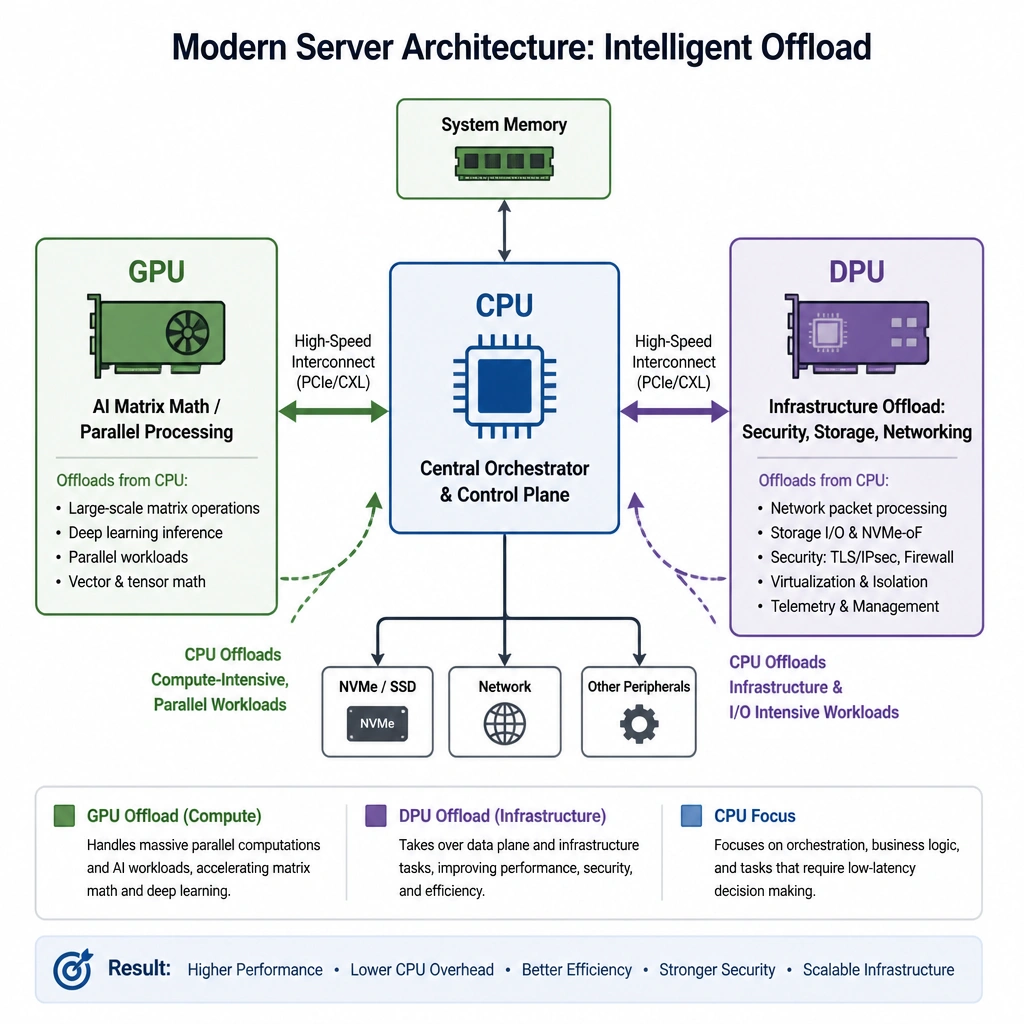
Let's break down the roles of these chips because the exam will definitely test you on this. Think of the CPU as the brain of the server—it handles the general operating system tasks and control logic. But it needs help. The GPU is your muscle for AI math; it has thousands of cores designed to crunch massive parallel matrix operations for model training and inference. The DPU (Data Processing Unit) is like your dedicated logistics manager. Instead of letting the CPU get bogged down by encrypting traffic, routing packets, or managing storage virtualization, the DPU handles those infrastructure tasks directly on the network card. This team effort lets the CPU focus on running your applications without getting slowed down by background noise.
Full explanation below image
Full Explanation
Modern accelerated computing nodes employ a heterogeneous architecture where different hardware engines specialize in distinct tasks to maximize efficiency. The Central Processing Unit (CPU) manages the host operating system, control flow, and general-purpose computing. The Graphics Processing Unit (GPU) features a highly parallel architecture designed to accelerate high-throughput matrix computations required for machine learning model training and inference. The Data Processing Unit (DPU) is a specialized smart network interface card containing programmable processor cores, hardware accelerators, and high-performance network interfaces. The DPU offloads network data packet processing (e.g., VxLAN encapsulation, firewalls, routing), storage virtualization (e.g., NVMe-oF), and encryption tasks directly from the host CPU. By dividing tasks this way, the CPU is freed from resource-intensive infrastructure overhead, and overall network throughput and compute efficiency are optimized.