An infrastructure manager at a hyperscale AI data center running thousands of NVIDIA Tensor Core GPUs wants to transition from reactive troubleshooting to a proactive operations model. The goal is to detect early-stage hardware anomalies and predict GPU failures before they cause training jobs to crash. Which strategy should they implement to achieve this?
Select an answer to reveal the explanation.
Short Explanation and Infographic
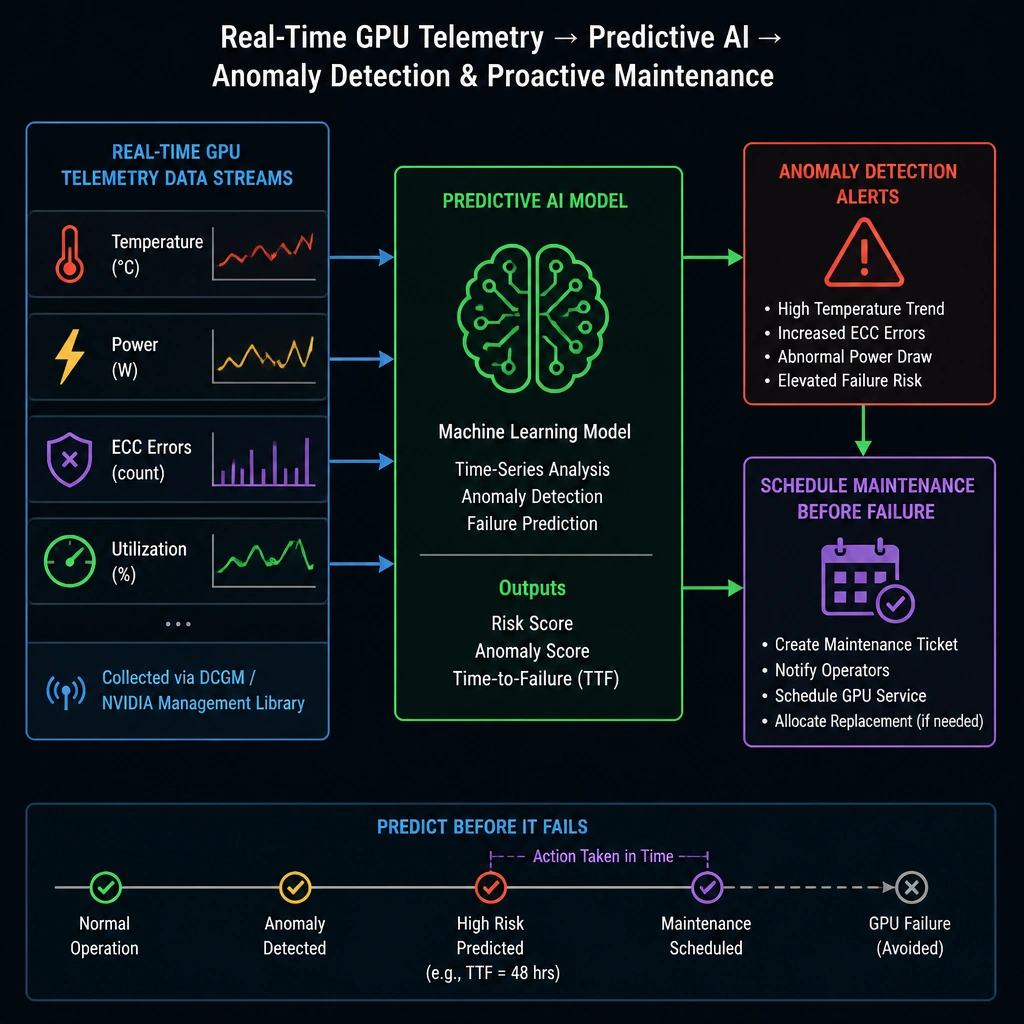
Check this out: if you're running a massive cluster of GPUs, you can't just wait around for a card to fry itself and kill a three-week training run. That's a great way to get your boss screaming at you! You also can't rely on simple static alerts like "hey, temperature hit 85 degrees." By then, it might already be too late. Here's the deal: you want to feed real-time telemetry—things like power draw, fan speed, memory error rates, and temperature—into an AI-based predictive maintenance system. It spots the weird, subtle anomalies before the hardware goes belly up. Trust me, proactive is the only way to live in production. Got it? Sweet. Let's keep rolling.
Full explanation below image
Full Explanation
In a high-density AI data center, GPU hardware failures are a leading cause of job interruptions and costly downtime. Traditional monitoring methods, such as simple threshold-based alerts (e.g., checking if temperature exceeds a certain limit) or periodic manual inspections, are inherently reactive or insufficient. They fail to capture complex, multi-variable degradation patterns that precede hardware failure. The most effective approach is a predictive maintenance system that ingests and analyzes high-frequency, real-time GPU telemetry data. This telemetry includes parameters such as voltage fluctuations, memory error rates (ECC errors), fan speeds, power consumption patterns, and thermals. Machine learning models trained on historical failure data can identify anomalous signatures across these metrics, predicting failures days or hours in advance. This allows operations teams to gracefully drain workloads from the affected node and schedule maintenance without interrupting active training runs. Let's look at why the other options fall short. Option A relies on batch scripts executed nightly; this is too slow and misses transient issues or sudden failures that occur during active training. Option B utilizes static thermal thresholds. While thermals are important, they are only a single metric. A GPU can fail due to memory degradation (SRAM/HBM) or power delivery issues without ever crossing a temperature threshold. Option D, manual log auditing, is slow, non-scalable, and prone to human error, making it completely impractical for modern, fast-paced AI infrastructures.