A networking engineer is optimizing a multi-node GPU cluster for a massive deep learning training job. They observe that the traditional network stack is introducing significant CPU overhead and high latency when transferring tensor gradients between GPU memories on different physical servers. Which technology should they implement to enable direct node-to-node memory transfers that bypass the OS kernel and host CPU?
Select an answer to reveal the explanation.
Short Explanation and Infographic
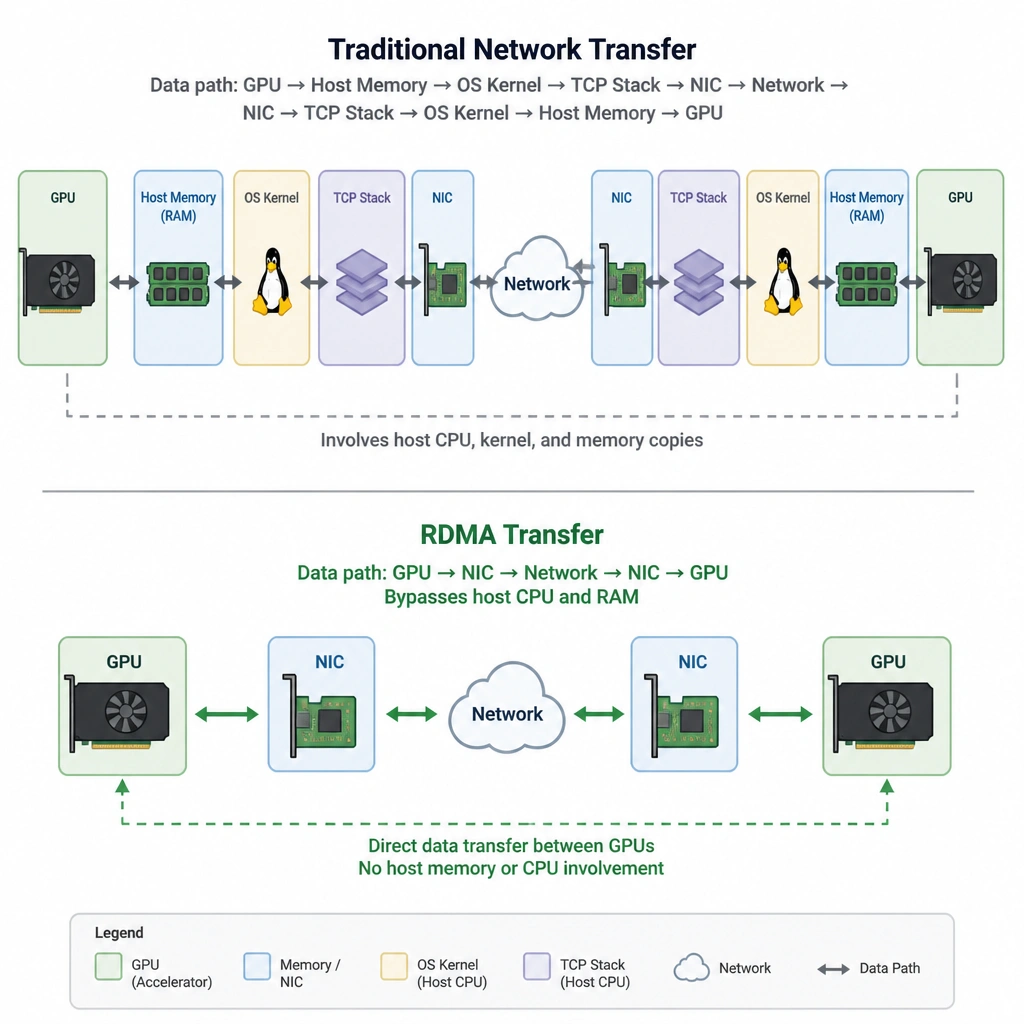
Here's the deal: when you're doing distributed training, GPUs need to talk to each other constantly to share gradients. If that traffic has to go through the operating system's network stack—meaning the host CPU has to package everything into TCP packets—your performance is going to tank. It's like sending a package by hand-delivering it to ten middle-men. You want to bypass the CPU and kernel entirely. That is exactly what InfiniBand with RDMA (Remote Direct Memory Access) does. It lets one GPU write directly into the memory of another GPU on a different node. Trust me on this, for high-performance AI clusters, RDMA is an absolute must.
Full explanation below image
Full Explanation
In distributed deep learning, models are split across multiple GPUs and nodes. During the backward pass, GPUs must synchronize gradients (typically using an AllReduce operation). If this communication relies on standard TCP/IP over Ethernet, the data must travel through multiple layers of the OS kernel and TCP stack, requiring CPU interrupts and memory copying. This creates a severe latency and throughput bottleneck. InfiniBand with Remote Direct Memory Access (RDMA) addresses this issue by allowing one computer to access the memory of another computer without involving either one's operating system or CPU. GPUDirect RDMA takes this a step further by allowing direct memory access between GPUs on different nodes across the network fabric. This bypasses the host CPU and system memory entirely, drastically reducing latency and maximizing throughput. Let's look at why the other options are incorrect. Option A (Standard TCP/IP over Ethernet) introduces high latency and CPU overhead due to packet encapsulation, buffer copying, and kernel interrupts, even at high speeds like 100 Gbps. Option C (VLAN segmentation) is used to isolate broadcast domains and secure traffic on a network. It does not bypass the CPU stack or accelerate memory transfers. Option D (NAT loopback routing) is a method for routing traffic from a private network back to itself through an external IP address. It adds routing overhead and has no acceleration benefits for node-to-node GPU communication.