You are designing an end-to-end pipeline for a large language model that processes terabytes of raw text data and trains across a cluster of NVIDIA DGX systems. To maximize training speed, you must eliminate the CPU bottleneck during data preparation (tokenization and loading) and optimize collective communication during distributed weight synchronization. Which combination of NVIDIA software libraries is designed specifically to address these two areas?
Select an answer to reveal the explanation.
Short Explanation and Infographic
Pay close attention here: a common pitfall in AI training is that the GPU sits idle waiting for the CPU to feed it data. That's a classic data loading bottleneck, and it's a huge waste of expensive hardware. NVIDIA DALI (Data Loading Library) fixes this by offloading and accelerating data preprocessing on the GPU. But we also have to coordinate those GPUs during training. NVIDIA NCCL (Collective Communications Library) is built specifically to handle multi-GPU and multi-node communications, making sure things like AllReduce run at lightning speed. Together, DALI feeds the beast, and NCCL makes sure the beasts collaborate efficiently. Got it? Sweet.
Full explanation below image
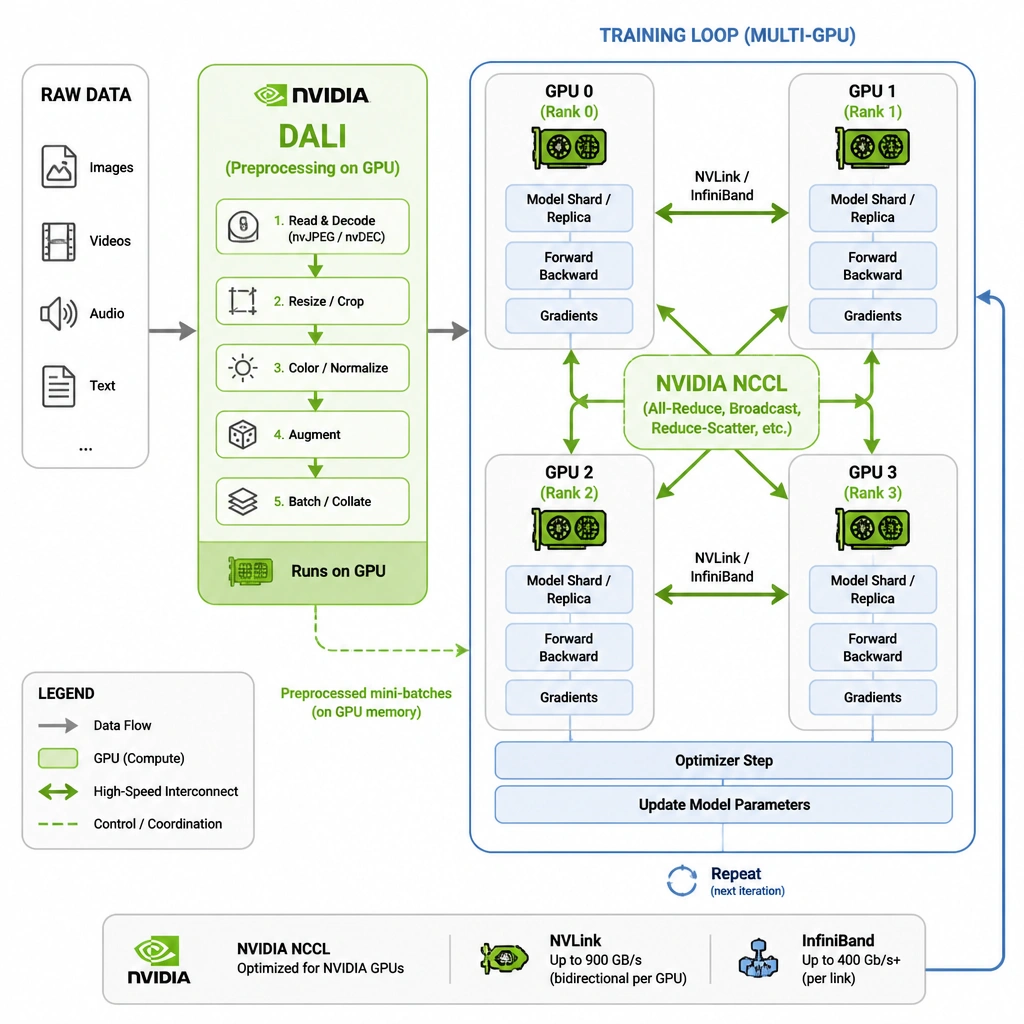
Full Explanation
To achieve maximum training efficiency on multi-GPU systems, developers must solve two major performance bottlenecks: data loading/preprocessing and inter-GPU communication. 1. NVIDIA DALI (Data Loading Library) is a collection of highly optimized building blocks designed to accelerate data pipelines for deep learning. Typically, data preprocessing (decoding, resizing, tokenization) is handled by the CPU, which can become a bottleneck, leaving the GPU underutilized. DALI offloads these operations to the GPU or optimizes them on the CPU, ensuring a continuous, fast stream of training data. 2. NVIDIA NCCL (NVIDIA Collective Communications Library) provides multi-GPU and multi-node collective communication primitives (such as AllReduce, AllGather, Reduce, Broadcast, and ReduceScatter) that are highly optimized for NVIDIA GPUs. NCCL automatically detects the underlying topology (such as NVLink, PCIe, or InfiniBand) and uses the fastest path to synchronize weights and gradients across devices, ensuring efficient distributed training. Let's look at why the other options are incorrect. Option A: NVIDIA TensorRT is an inference optimizer, not used for training pipelines. DGX OS is an operating system, not a software library for data loading or collective communication. Option B: cuDNN is a GPU-accelerated library for deep neural network primitives (like convolutions and pooling), and the NGC Catalog is a repository of pre-trained models and containers. While they are useful, they do not directly solve data loading bottlenecks or multi-GPU collective communication. Option D: DeepStream SDK is designed for multi-sensor processing and video/audio analytics (inference pipelines), and the CUDA Toolkit is the general development environment, not the specific libraries for these tasks.