In modern high-performance AI data centers, architecture teams are increasingly deploying Data Processing Units (DPUs) alongside CPUs and GPUs. What primary function does the DPU perform in this architectural model?
Select an answer to reveal the explanation.
Short Explanation and Infographic
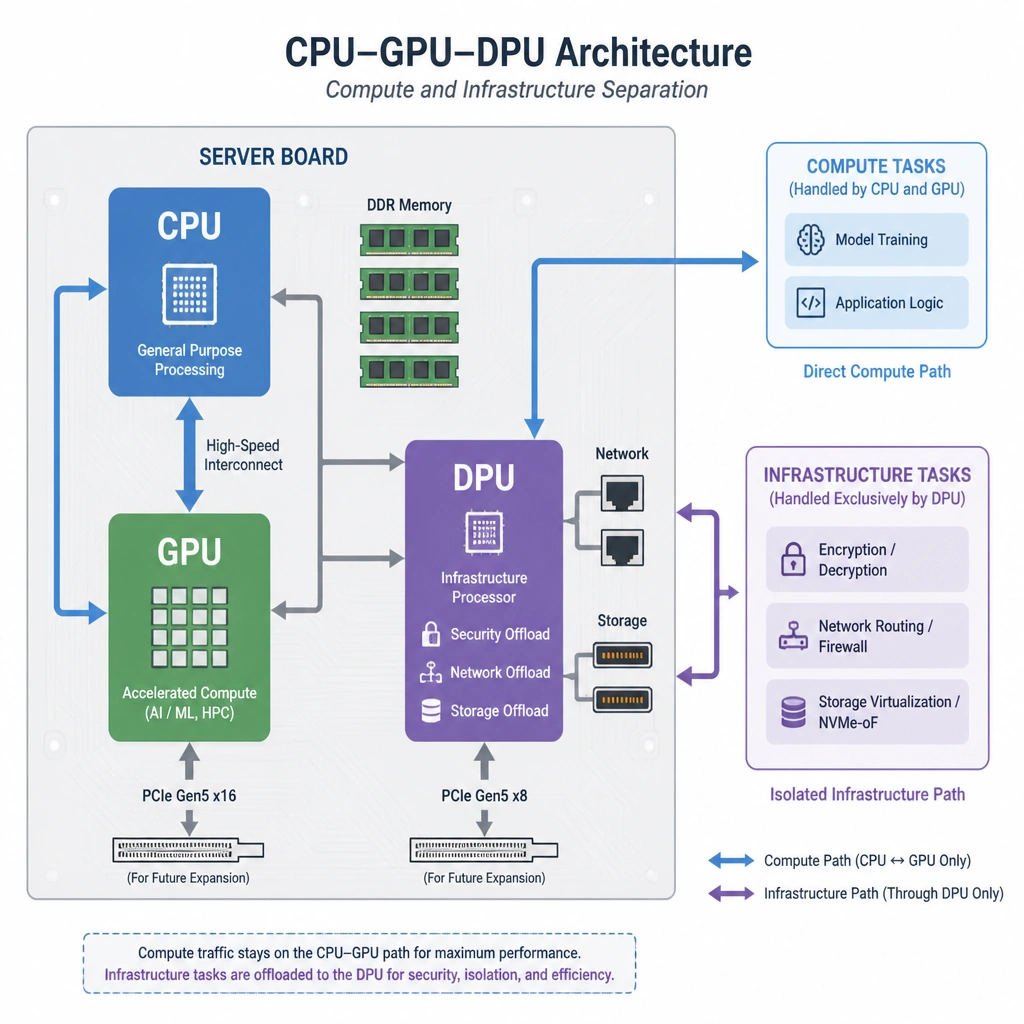
Here's the deal: CPUs are the brain of the server, and GPUs are the muscle for massive math problems like AI training. But in a huge data center, there's a ton of overhead—things like moving data across the network, encrypting packets, and managing storage disks. If the CPU has to spend half its time dealing with network packets and storage virtualization, it can't feed the GPU fast enough. Enter the DPU, or Data Processing Unit. Think of it as a smart network card on steroids. It has its own processor cores, memory, and acceleration engines to handle all that infrastructure grunt work. By offloading networking, storage, and security to the DPU, your CPU and GPU can focus entirely on doing what they do best: crunching AI workloads. Trust me, in a high-speed AI cluster, DPUs are key to keeping efficiency high.
Full explanation below image
Full Explanation
A Data Processing Unit (DPU) is a specialized class of programmable processor designed to manage data movement throughout the data center. In traditional architectures, the host CPU is responsible for handling networking stacks (like TCP/IP or RoCE), storage virtualization protocols (like NVMe-oF), and security tasks (such as TLS encryption or firewall rules). As network speeds scale to 200Gbps and 400Gbps, managing these tasks can consume a significant percentage of host CPU cores, a phenomenon known as the 'tax' on host compute.
A DPU combines high-performance network interfaces with programmable multicore CPUs and hardware acceleration engines. By offloading network, storage, and security tasks to the DPU: - The host CPU is freed from packet processing and virtualization overhead, allowing it to focus entirely on application logic and data prep. - The GPUs receive data faster via optimized direct memory access paths (like GPUDirect RDMA), reducing idle times. - Security is enhanced because the control plane is physically isolated on the DPU, separate from the application operating system.
This makes DPUs (such as the NVIDIA BlueField series) essential components of modern AI fabrics, working alongside GPUs and CPUs to maximize overall system throughput and efficiency.