When drafting an organizational Conflict of Interest (COI) policy, which of the following provisions is a fundamental requirement?
Select an answer to reveal the explanation.
Short Explanation and Infographic
Here's the deal: conflicts of interest are like weeds in your garden. They pop up all the time, and if you ignore them, they'll choke out everything else. A conflict of interest happens when your personal life or side gigs clash with your job duties. Say your brother-in-law runs a software company, and you're in charge of picking our next IT vendor. See the issue? A good COI policy doesn't mean you can't have external interests. It just means you must disclose them. Once it's out in the open, the compliance team can manage it—maybe by keeping you out of the decision-making loop. Honesty and transparency are key here. Got it? Sweet.
Full explanation below image
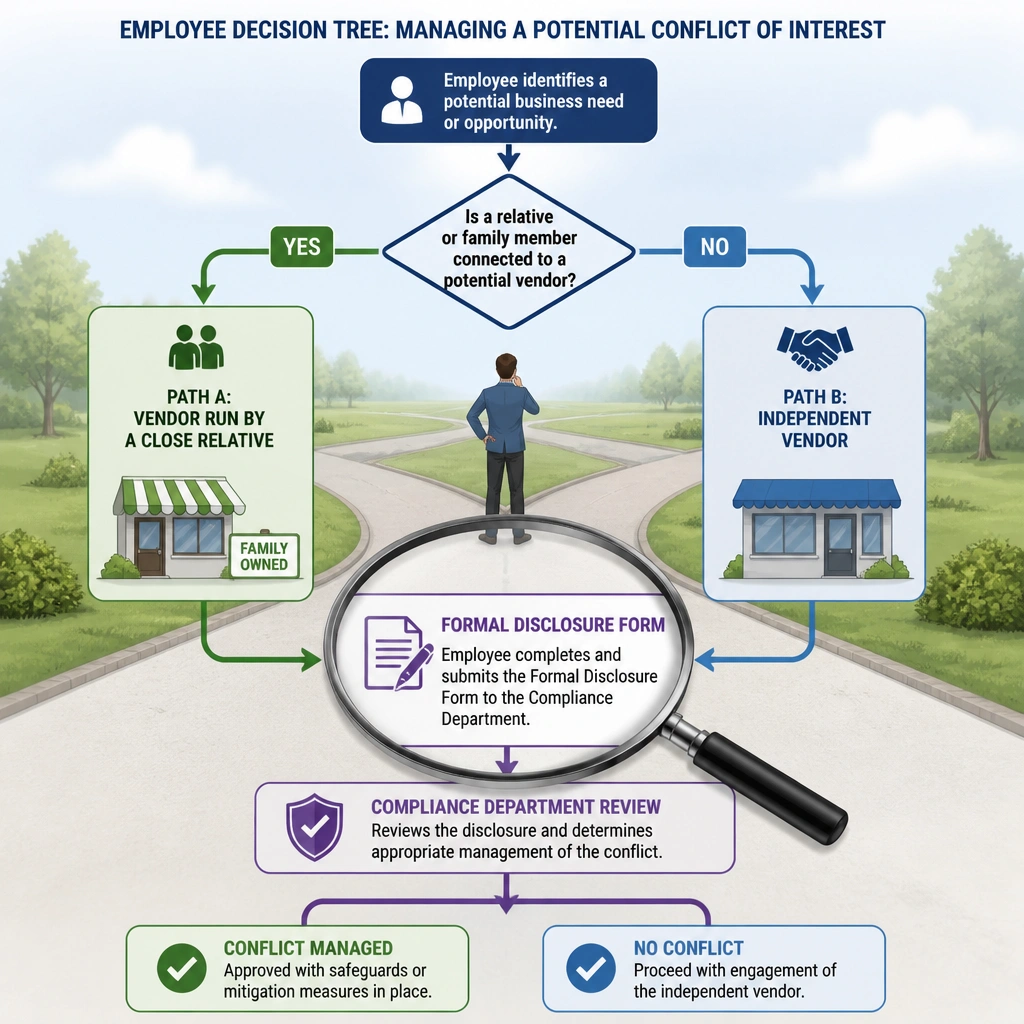
Full Explanation
A conflict of interest (COI) arises when an employee's personal, social, financial, or political activities interfere—or appear to interfere—with their loyalty to the employer or their ability to make objective business decisions. Because conflicts of interest can lead to fraud, biased decision-making, and reputational damage, organizations implement formal COI policies. The cornerstone of any effective COI policy is disclosure. Rather than attempting to ban all external relationships or activities, the policy requires employees to identify and report potential, actual, or apparent conflicts to the compliance officer or management. This transparency allows the organization to evaluate the situation and implement appropriate mitigation strategies, such as recusal from purchasing decisions or structured firewalls.
Option B is correct because formal disclosure of external activities, investments, or relationships that could influence business judgment is the standard mechanism of a COI policy.
Option A is incorrect because general personal friendships outside of work do not need to be disclosed unless they intersect with the company's business interests, such as a friendship with a key vendor's representative. A policy requiring reporting of all personal friendships would be overly intrusive and unenforceable.
Option C is incorrect because a conflict of interest policy is designed to prevent employees from putting personal gain ahead of the company's interests, not to encourage or authorize it.
Option D is incorrect because professional development and education do not represent a conflict of interest; they are positive activities that benefit both the employee and the organization.