Under the U.S. Federal Sentencing Guidelines for Organizations (FSGO), what key factor must a corporation demonstrate to qualify for a reduction in culpability score if an employee commits a federal crime?
Select an answer to reveal the explanation.
Short Explanation and Infographic
Now, here's where it gets interesting for you: the U.S. Sentencing Guidelines are the actual rules judges use to determine how hard a company gets hit when an employee breaks the law. If you just have a 'paper compliance program'—meaning you wrote some policies, threw them in a drawer, and forgot about them—you're going to get hammered. The guidelines emphasize that you must have an active, ongoing, and effective compliance program. You have to prove you are actually monitoring, educating, and enforcing the rules day in and day out. That's what saves your company from massive fines.
Full explanation below image
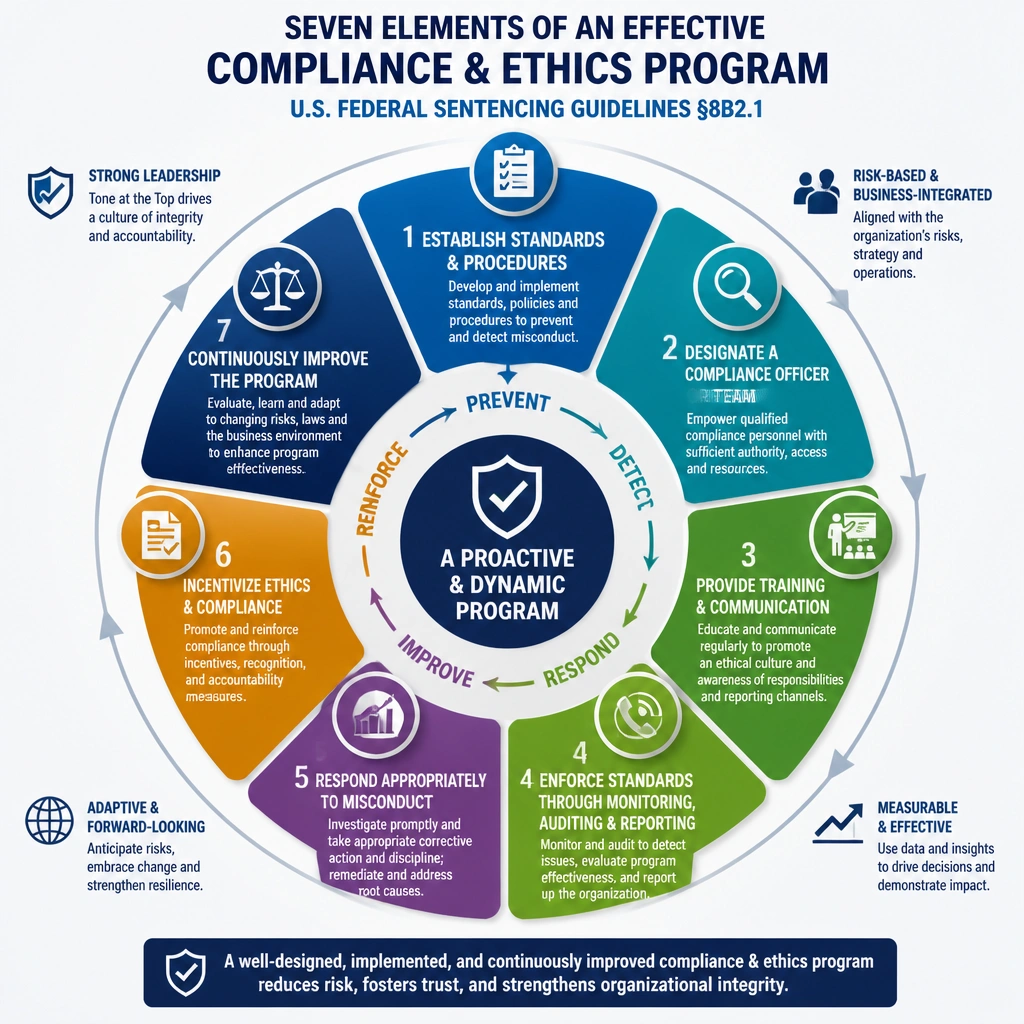
Full Explanation
The U.S. Federal Sentencing Guidelines for Organizations (FSGO) outline seven key elements of an effective compliance and ethics program. If an organization can demonstrate that it has established and maintained an effective, active program prior to an offense occurring, it can receive a significant reduction in its culpability score. This reduction can drastically reduce the monetary fines and probation terms imposed on the corporation. The guidelines make it clear that a compliance program must be dynamic, adequately resourced, and integrated into the company's daily operations rather than existing solely on paper.
Let's explore why B is the correct answer and the others are incorrect. B is correct because the FSGO explicitly focuses on the operational effectiveness of the program as a whole, requiring evidence that the program is actively promoted and enforced throughout the organization.
Distractor A is incorrect because a code of conduct alone is insufficient; the guidelines require high-level oversight and dedicated personnel (such as a compliance officer) to oversee the program. A program without resources or personnel is considered a 'paper program.'
Distractor C is incorrect because a reactive approach is considered ineffective compliance management; the FSGO expects proactive risk assessments, monitoring, auditing, and self-policing.
Distractor D is incorrect because while disciplinary action is required, an automatic and indiscriminate punitive approach without root-cause analysis does not constitute an effective or fair compliance program.