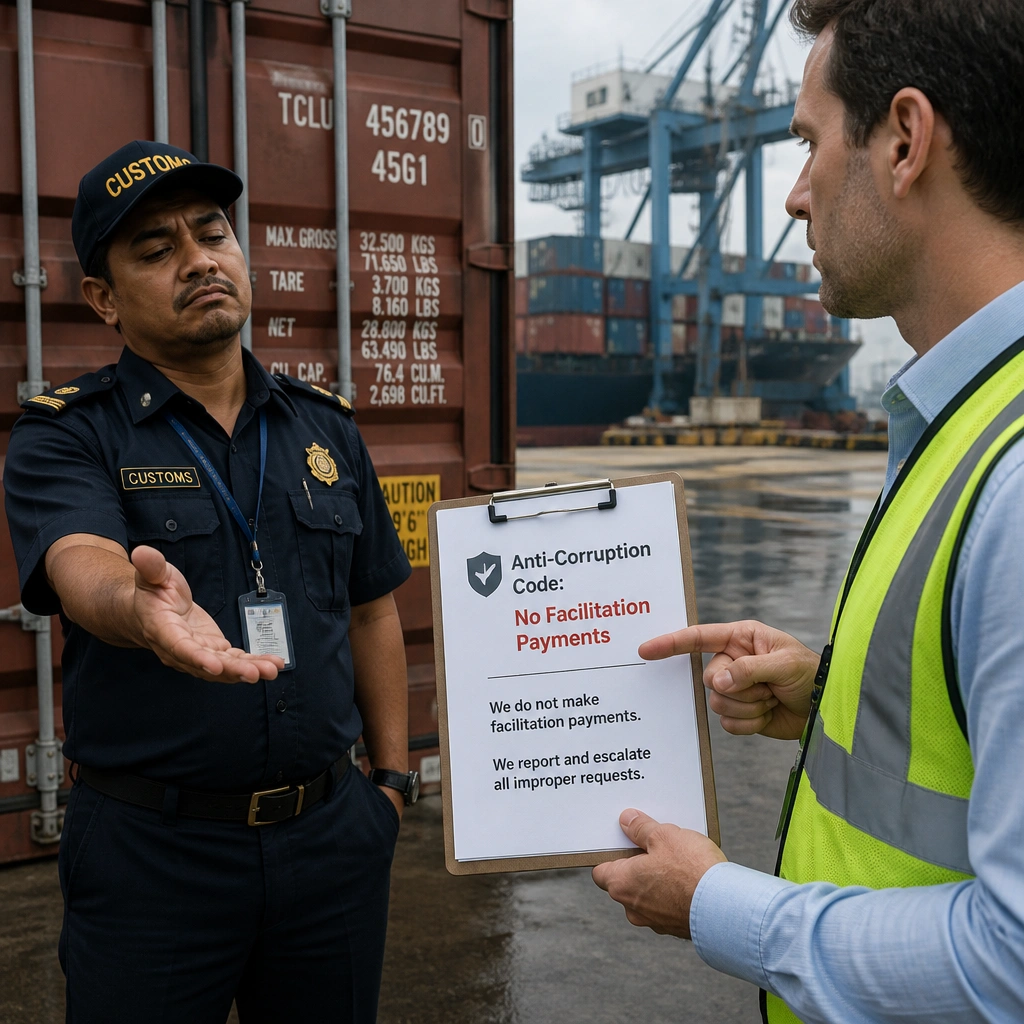
A company's code of conduct strictly prohibits the payment of "facilitation payments" (grease payments). During an international shipment delivery, a local customs official requests a minor cash payment from a logistics coordinator to expedite the release of a delayed cargo container. What is the correct course of action for the employee?
Select an answer to reveal the explanation.
Short Explanation and Infographic
Pay close attention here, because this one bites people in production all the time. A 'facilitation payment'—often called a grease payment—might seem harmless. It's just a few bucks to get your container through customs, right? Wrong! Under many anti-corruption policies and laws like the UK Bribery Act, these payments are illegal bribes, plain and simple. If your company policy bans them, you cannot pay. Period. You must refuse the payment and report it to compliance or legal immediately. Don't try to hide it or explain it away as an operational expense. Go with B!
Full explanation below image
Full Explanation
Facilitation payments, commonly referred to as "grease payments," are small payments made to low-level government officials to secure or expedite the performance of routine, non-discretionary governmental actions (such as issuing permits, processing visas, or releasing goods through customs). While the U.S. Foreign Corrupt Practices Act (FCPA) contains a narrow exception for facilitation payments, many international laws (such as the UK Bribery Act) and strict corporate compliance policies prohibit them entirely.
When a company's policy bans facilitation payments, employees must adhere to this standard without exception. Paying a customs official, regardless of the amount, violates company policy and potentially local laws. The correct action is to decline the request, explain that company policy prohibits such payments, and report the encounter to the compliance department or legal team. This allows the company to document the solicitation, intervene through legal channels, and protect the employee and organization from liability.
Let's review why the alternative options are incorrect: - Option A is incorrect because paying a bribe, even a small one, violates the company's zero-tolerance policy and can establish a pattern of corruption. - Option C is incorrect because obtaining a receipt does not make an illegal or non-compliant payment legitimate. - Option D is incorrect because paying first and reporting later still constitutes a policy violation. The compliance team must be involved before any payment is made to ensure proper legal steps are taken.
In conclusion, refusing the payment and reporting the solicitation (Option B) is the only compliant course of action when faced with facilitation demands.