When senior executive leadership and middle management fail to actively support, resource, and model the company’s compliance program, which of the following represents the most significant organizational risk?
Select an answer to reveal the explanation.
Short Explanation and Infographic
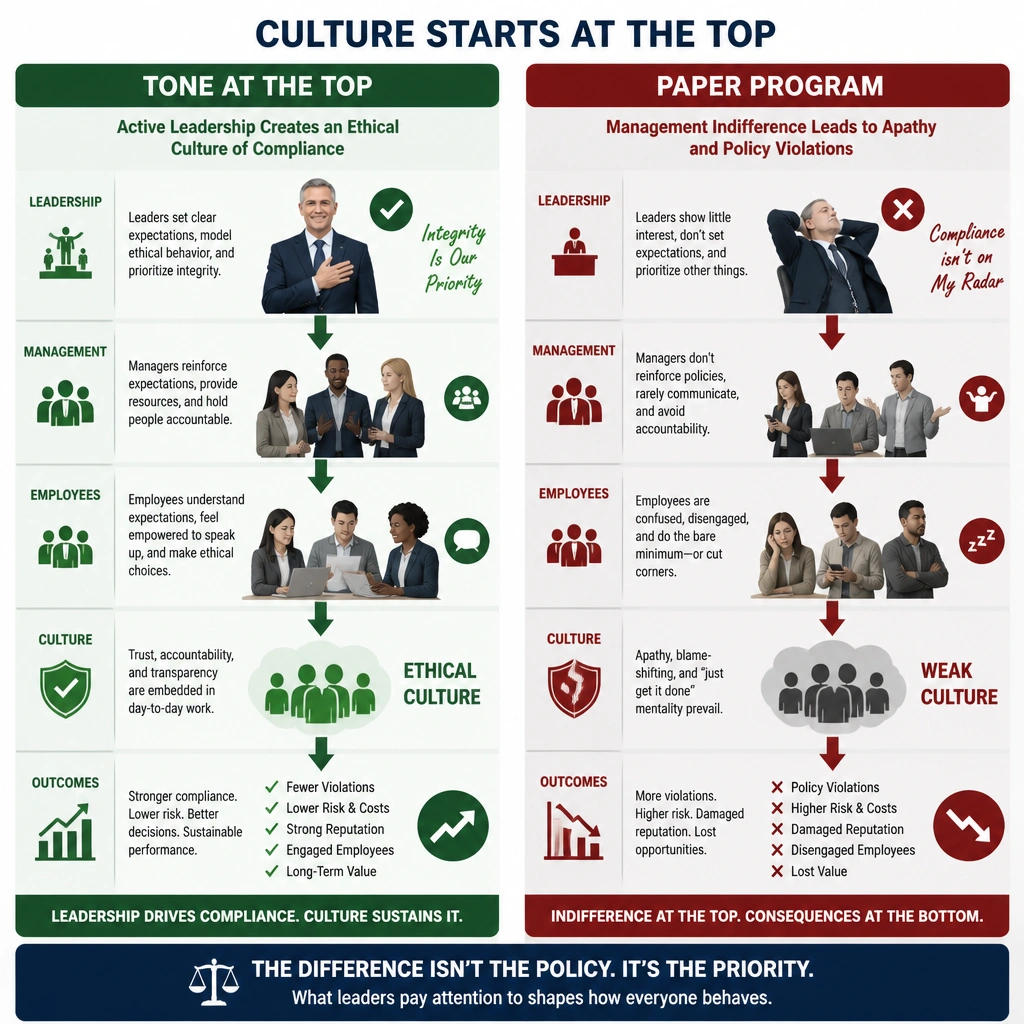
Check this out: in compliance, we talk about the 'tone at the top' all the time. Why? Because if the CEO and the VP of Sales are constantly cutting corners or rolling their eyes during training, your compliance program is dead on arrival. Employees watch what leaders do, not just what they say. If management doesn't buy in, the whole program is seen as a joke—just a bunch of checkboxes to keep the lawyers happy. Now, some folks might think a lack of support just makes a program too short or too expensive, but those are just logistical side issues. The real threat is cultural. If your leaders treat compliance like a nuisance, your employees will too. And trust me, when the regulators come knocking, a 'paper program' that nobody takes seriously will not save the company from massive penalties. Leadership must walk the walk!
Full explanation below image
Full Explanation
The concept of 'tone at the top' is a foundational element evaluated by regulatory bodies, such as the U.S. Department of Justice (DOJ), when assessing whether a compliance program is effective or merely a "paper program." When management fails to actively support compliance initiatives, the program loses its legitimacy and authority. Employees take cues from leadership; if executives bypass policies or treat compliance as an administrative hurdle, employees will prioritize business results over ethical standards. This cultural gap leads to widespread non-compliance and increases the risk of systemic legal violations. Let's analyze the incorrect choices: - Option B is incorrect because a lack of management support does not legally or technically prohibit a company from purchasing compliance software; rather, it makes the software ineffective due to a lack of operational utilization and enforcement. - Option C is incorrect because training duration is a design characteristic, and while resource constraints might affect training development, the physical length of a course is not the primary risk of management indifference. - Option D is incorrect because a lack of management support usually leads to the underfunding or starving of the compliance function, rather than an automatic budget increase. Therefore, active leadership support is crucial to establishing an ethical culture where compliance is integrated into daily business decisions.