NVIDIA's accelerated computing platform is used across many fields, but which sector has been most fundamentally restructured by using end-to-end NVIDIA AI infrastructure to run massive physics-based simulations, train deep neural networks, and safely test complex systems in virtual environments before physical production?
Select an answer to reveal the explanation.
Short Explanation and Infographic
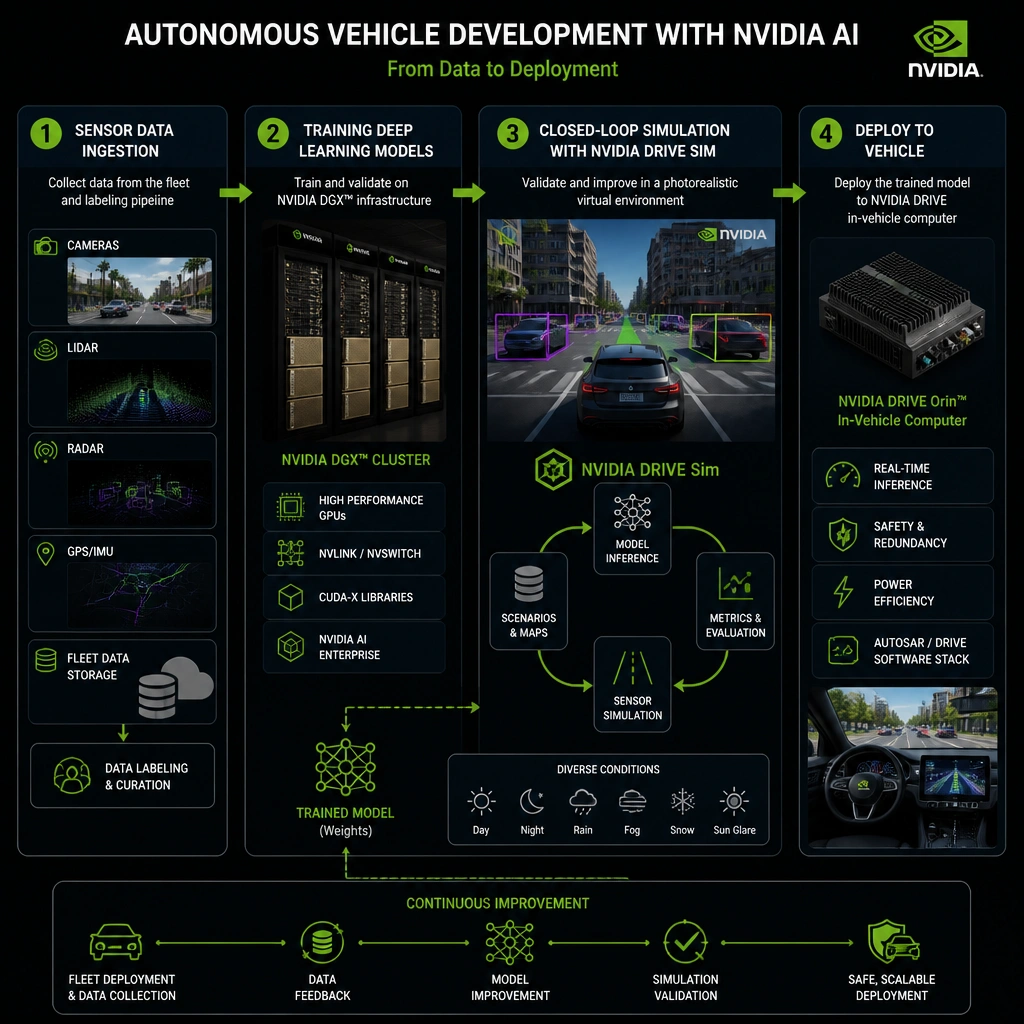
Let me show you how this works in the real world. Think about self-driving cars. You can't just write some code, put it in a vehicle, and hope it doesn't hit a wall. You have to test it across billions of virtual miles in every weather condition imaginable before it ever touches a real road. NVIDIA built an entire platform called NVIDIA DRIVE just for this. They use massive GPU clusters to simulate virtual worlds, train the deep learning models that 'see' the road, and test the vehicle's brain in real-time. While retail, finance, and agriculture use GPUs, none of them have been turned upside down quite like the automotive space by this kind of end-to-end AI infrastructure. Trust me on this one! Let's keep rolling.
Full explanation below image
Full Explanation
NVIDIA's AI infrastructure has had a profound impact on the automotive industry, particularly through its specialized platforms like NVIDIA DRIVE. Developing autonomous vehicles (AVs) requires an immense amount of compute power to handle data ingestion, deep neural network (DNN) training, and high-fidelity simulation. Instead of relying solely on physical test fleets—which is slow, expensive, and dangerous—automotive developers use NVIDIA GPUs to simulate millions of driving scenarios in virtual environments. These simulations test vehicle software against edge cases (like sudden weather shifts or erratic pedestrian behavior) in a fraction of the time it would take in the physical world. This massive parallel testing capability accelerates design iterations and significantly reduces time-to-market. While retail (Option A) benefits from GPU-accelerated recommendation engines, finance (Option C) leverages accelerated computing for fraud detection and risk modeling, and agriculture (Option D) uses computer vision for smart farming, the end-to-end transformation of autonomous vehicle development in the automotive industry (Option B) stands as the most dramatic architectural shift powered by NVIDIA's hardware and software ecosystem.