When an organization requires employees to sign an annual attestation or certification for the Code of Conduct, what is the primary objective of this process?
Select an answer to reveal the explanation.
Short Explanation and Infographic
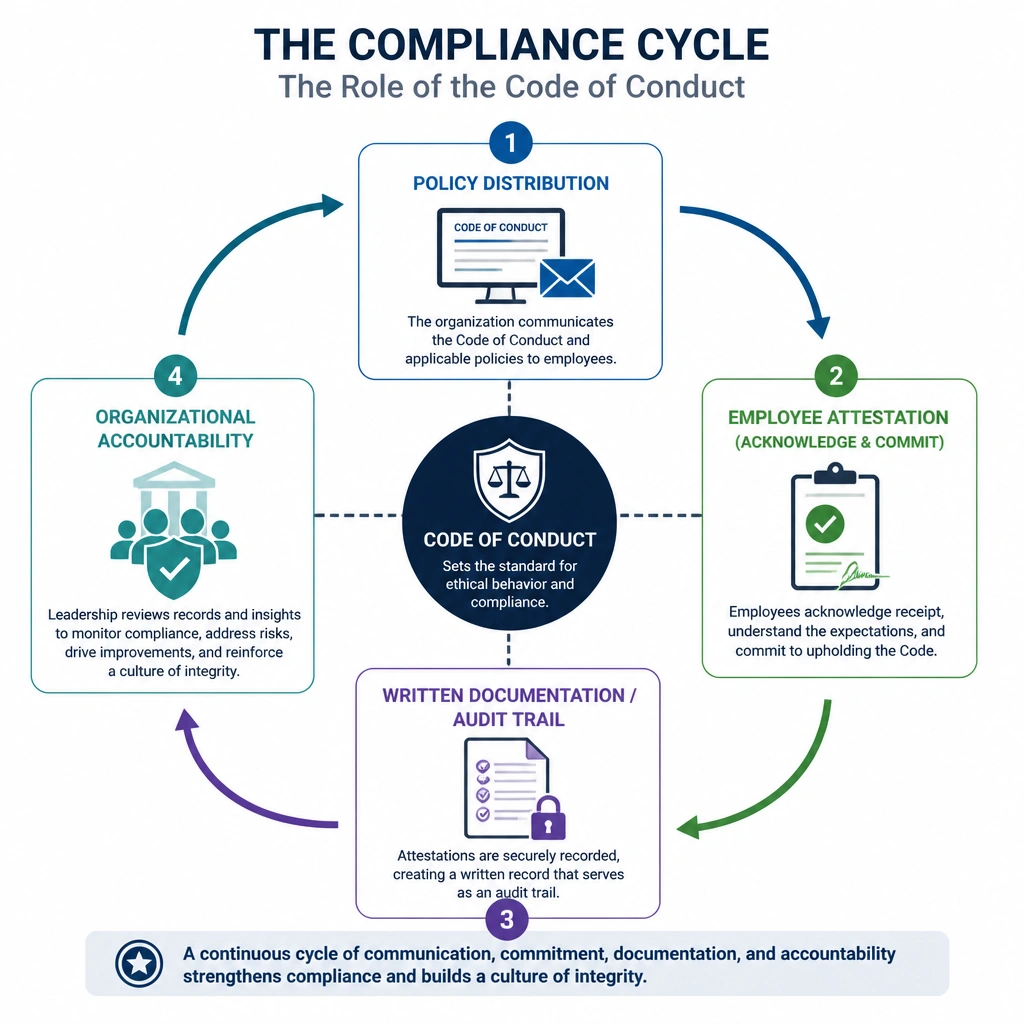
Here's the deal: having a beautiful Code of Conduct sitting on a shelf doesn't do you any good if nobody reads it. That's where attestations come in. When employees sign that document, they're saying, 'Yep, I read it, I understand it, and I promise to play by the rules.' Think of it like signing for a package — you can't claim you never got it. It builds accountability and gives the compliance team a paper trail to show that they are actively pushing the code out to the workforce. It won't stop a bad actor from breaking the rules, but it sure keeps everyone honest and documented.
Full explanation below image
Full Explanation
An annual Code of Conduct attestation (or certification) serves several crucial compliance functions. First, it ensures that employees acknowledge they have received, read, and understood the organization's core ethical standards. Second, it documents each individual's commitment to adhere to those standards, creating accountability. From a regulatory perspective, this documentation is essential. If a regulatory body investigates the organization, the compliance department must be able to prove that policies were actively disseminated and acknowledged by the workforce.
- Correct Answer is C because certifications confirm receipt, comprehension, and commitment while establishing a defensible audit trail of compliance communication. - Distractor A is incorrect because certifications do not replace training; they complement it. Training teaches employees how to apply the policies in real-world scenarios. - Distractor B is incorrect because an attestation cannot guarantee perfect compliance or prevent all future violations; human behavior remains unpredictable. - Distractor D is incorrect because attestations are internal compliance documents meant to establish accountability and understanding, not mechanisms for disclosing personal employee information to the public.