A corporate internal audit department restricts its reviews solely to financial controls and accounting procedures, omitting compliance checks for data privacy regulations and anti-bribery standards. Which of the following best describes this program deficiency?
Select an answer to reveal the explanation.
Short Explanation and Infographic
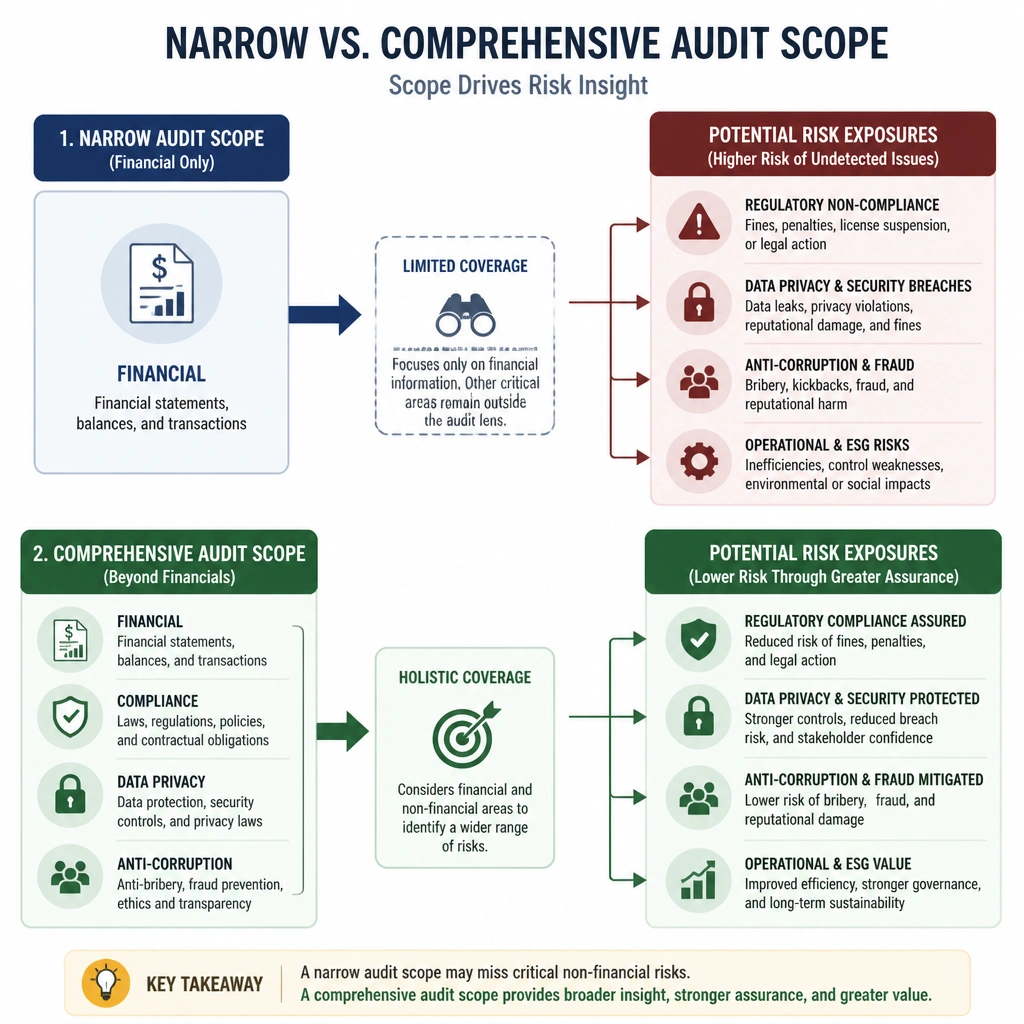
Imagine buying a home security system but only putting sensors on the front door while leaving all the back windows wide open. That's exactly what's happening here! If your internal audit team is only checking the financial books and completely ignoring compliance areas like data privacy and anti-corruption, you've got a massive blind spot. The issue here isn't how they test; it's what they are testing. In other words, the scope of your audit program is way too narrow. In the real world, regulatory fines for data breaches or bribery can dwarf standard financial errors. You have to make sure your audit scope covers the entire risk landscape, not just the accounting ledger. Nice and clean!
Full explanation below image
Full Explanation
An effective compliance and monitoring program requires that the internal audit function has a scope broad enough to cover all material risks facing the organization. While financial controls are a critical component of any audit program, focusing on them to the exclusion of regulatory compliance areas—such as data privacy (e.g., GDPR, CCPA) and anti-corruption laws (e.g., FCPA)—creates a severe risk vulnerability. This is categorized as a scope deficiency because the audit plan fails to encompass key operational and compliance risks. Preventative transaction controls refer to barriers put in place to stop errors or fraud before they occur; an audit program is a detective or monitoring function, not a preventative control. Commercial marketing strategies are external market-facing initiatives and are unrelated to the internal audit department's structural oversight responsibilities. Detective controls in IT operations are specific technical measures used to discover unauthorized actions; while IT controls are relevant to data privacy, the root issue is the overall lack of audit coverage across these compliance domains, which is a fundamental audit scope weakness. A comprehensive audit scope must be risk-based, aligning with all legal, regulatory, and operational risks of the organization.