To maintain regulatory alignment and mitigate emerging threats, how should an organization approach the operational execution of its compliance risk assessment process?
Select an answer to reveal the explanation.
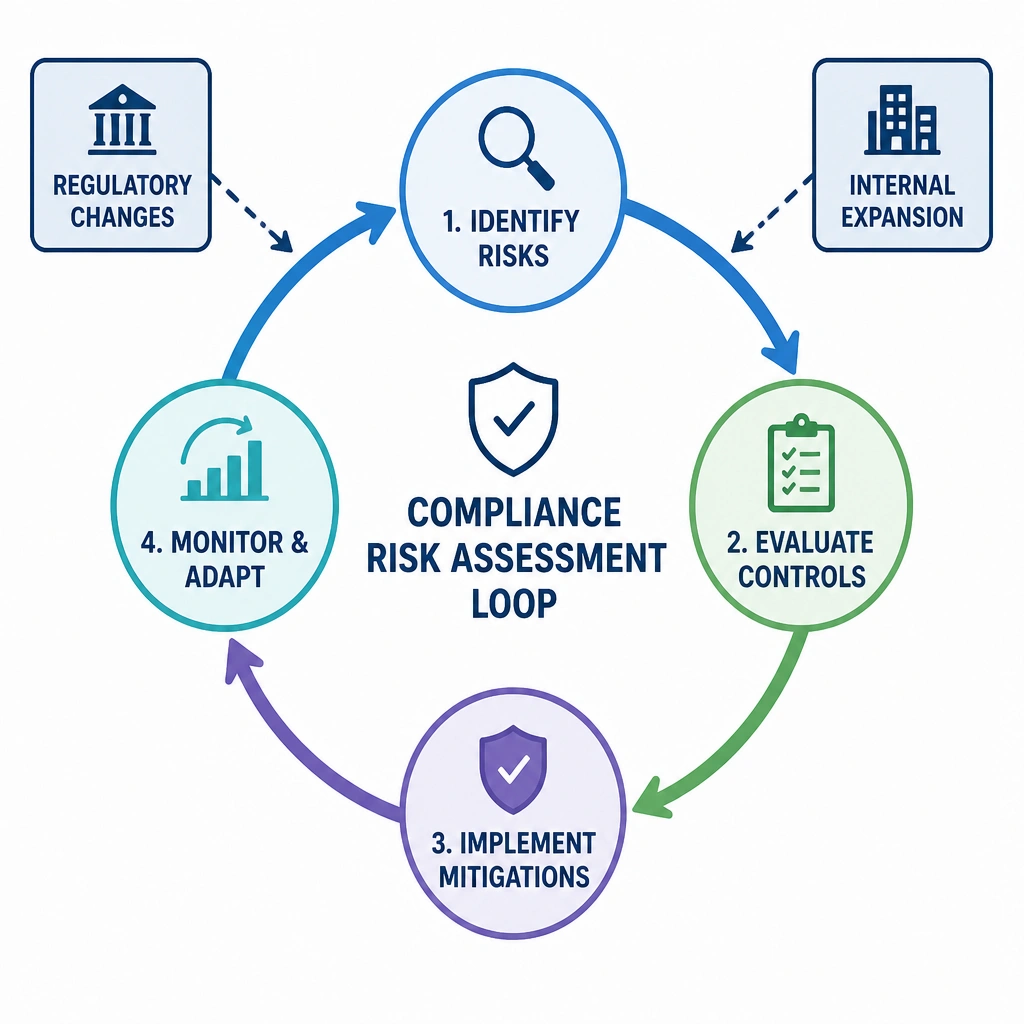
Short Explanation and Infographic
Check this out: think of a risk assessment like driving a car. You wouldn't just look at the road once when you start the engine, close your eyes, and hope for the best, right? Of course not! The road changes, other cars move, and sometimes you hit unexpected construction. In the compliance world, the environment is just as dynamic. New laws are passed, your company launches new products, or maybe you acquire a competitor. If your risk assessment is a static binder sitting on a shelf from three years ago, you're driving blind. It's got to be a continuous, living process that adjusts as your business and the external world change. Pay close attention here, because assuming risk assessment is a 'one-and-done' task is a major trap that catches companies in regulatory crosshairs all the time. Keep it moving, keep it updated!
Full explanation below image
Full Explanation
An effective compliance risk assessment is not a static event but a dynamic, ongoing management process. Regulatory guidance, including the Department of Justice's (DOJ) Evaluation of Corporate Compliance Programs, emphasizes that a compliance program should be constantly evolving based on continuous risk assessments.
Option C is correct because risk assessment must be continuous and adaptive. An organization's risk profile changes constantly due to factors such as entering new geographic markets, introducing new products, technological advancements, organizational restructuring, or changes in laws and regulations. A continuous loop of assessment, mitigation, and re-evaluation ensures that the compliance program remains tailored to the company's actual, current risk profile.
Option A is incorrect because while external auditors or consultants can provide valuable independent oversight, relying exclusively on them ignores the critical need for internal operational knowledge and ownership of risks. Additionally, a static audit is insufficient for risk management.
Option B is incorrect because compliance risk extends far beyond financial risks. It encompasses operational, legal, reputational, data privacy, environmental, health and safety, and employment risks. Focusing solely on financial risks leaves massive vulnerabilities unaddressed.
Option D is incorrect because a one-time baseline project will quickly become obsolete. It fails to account for new regulatory threats or internal changes, rendering the established controls ineffective over time.
Best practices for compliance risk assessments include establishing a cross-functional risk committee, utilizing data analytics to monitor risk indicators in real time, and systematically updating policies and training materials in response to new risk findings.