When a corporation establishes its compliance department as an isolated silo, operating independently with minimal day-to-day integration into core business units and operational workflows, what is the primary compliance risk?
Select an answer to reveal the explanation.
Short Explanation and Infographic
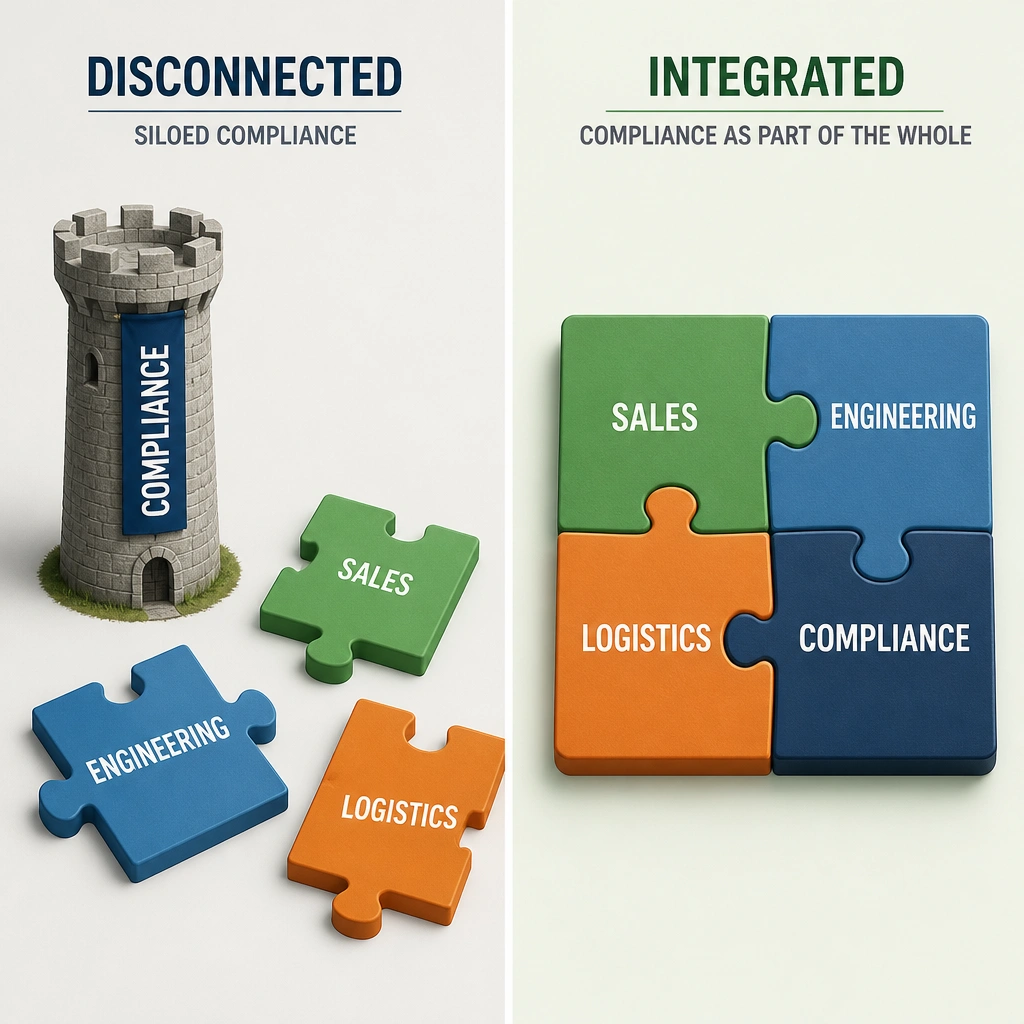
Imagine your company's compliance team lives in an ivory tower on the top floor, never talks to sales, engineering, or operations, and only sends down thick PDFs of rules. What's going to happen? The folks on the ground doing the actual work are going to view compliance as a bunch of bureaucratic red tape that just slows them down. They'll start finding workarounds, ignoring procedures, and keeping the compliance team in the dark. That's a massive risk. Let me show you how this works in the real world: compliance cannot be a standalone police force. It has to be baked into the daily operations of the business. When compliance officers sit down with the business units, understand their goals, and help them achieve those goals safely, that's when you build a real culture of integrity. If you keep them isolated, you're just begging for trouble.
Full explanation below image
Full Explanation
For a compliance program to be effective, it must be integrated into the organization's daily business operations. The Department of Justice (DOJ) guidelines for evaluating compliance programs evaluate whether the compliance team is integrated into the business or if it is treated as a separate, check-the-box exercise.
Option B is correct because isolating the compliance department leads to a perception that compliance is merely a bureaucratic hurdle. When business units view compliance as an detached administrative burden, they are far more likely to bypass controls, omit compliance reviews from new initiatives, and fail to report potential violations. This lack of integration prevents compliance from serving as a strategic partner and leads to a weakened ethical culture across the organization.
Option A is incorrect because isolation does not inherently cause exponential cost increases. In fact, isolated compliance departments are often underfunded and understaffed because they lack visibility and support from the business units.
Option C is incorrect because isolated compliance functions tend to shrink or remain small because they are not viewed as core business assets.
Option D is incorrect because isolation typically leads to compliance rules that are more complex and academic, rather than too simplistic, because they are written without practical input from the operational teams.
Best practices to avoid this silo effect include appointing compliance champions within business units, involving compliance early in the product development and sales planning cycles, and evaluating business managers on the compliance health of their departments.